There is a persistent idea that 5.56 is the boring default and that serious builders have moved on to something better. The AR platform will happily accept a long list of cartridges, and most of them have enthusiastic advocates.
The barrels people actually buy tell a different story.
The mix
Barrel selections by cartridge
| Item | Share (%) |
|---|---|
| 5.56 / .223 | 66% |
| Unlabelled | 17% |
| 300 Blackout | 10% |
| .308 / 7.62 | 3% |
| 6mm ARC | 2% |
| 9mm | 2% |
Two thirds of barrel selections are 5.56 or .223. Add the unlabelled slice, which is overwhelmingly standard chamberings whose listings simply do not state the cartridge clearly, and the real 5.56 share is higher still.
300 Blackout is the clear second, and it is the only alternative cartridge with a share large enough to call mainstream. Everything else, including the cartridges that generate the most discussion, sits in low single digits.
Why 5.56 keeps winning
- Ammunition cost and availability. Nothing else on the list is close. You can buy it anywhere, in bulk, at a price that makes regular practice affordable, and practice improves your shooting more than ballistics do.
- Parts compatibility. A 5.56 build uses standard bolts, magazines and gas systems. Every alternative cartridge adds at least one compatibility question.
- It is enough gun for the job. Inside a few hundred yards, against the targets most people actually shoot, 5.56 does the work.
When 300 Blackout is the right answer
300 Blackout earns its second place honestly, and it exists for one specific reason: it was designed from the start to work suppressed, from a short barrel, using standard AR-15 magazines and bolts.
That combination is genuinely hard to replicate. A 300 Blackout upper reaches full velocity in a very short barrel, where 5.56 is still losing performance, and subsonic 300 Blackout through a suppressor is quiet in a way 5.56 never is.
If you are building a short, suppressed rifle, it is the right call. If you are building a 16 inch general purpose carbine, it is an expensive way to get less range and costlier ammunition.
The intermediate cartridges
6mm ARC and 6.5 Grendel both do something real: they extend the useful range of an AR-15 sized action well past what 5.56 manages, with better ballistic coefficients and better wind performance at distance.
The cost is ammunition price and availability, a dedicated bolt, and in most cases magazines that are specific to the cartridge family. For a rifle that will be shot at distance regularly, that cost is worth paying. For a rifle that will mostly be shot at a hundred yards, it is a lot of friction for capability you will not use.
Our data suggests most builders reach the same conclusion.
The .308 question
The .308 and 7.62 share here is small because those cartridges mostly live on the larger AR-10 pattern rather than the AR-15, and AR-10 builds are a smaller population overall. If you want a .308, you are choosing a different, heavier platform rather than a different barrel.
What we would tell a first-time builder
Build the first one in 5.56. It is the cheapest to feed, the easiest to source parts for, and the most forgiving of mistakes, and you will learn more from shooting it a lot than from owning something more interesting you shoot rarely.
Add a second upper later if you want to experiment. That is the real advantage of this platform: the lower receiver is the serialised part, and a second upper in another cartridge is a much cheaper experiment than a second rifle.
If your second upper is 300 Blackout, keep it short and put a suppressor on it, because that is the configuration the cartridge was designed for and where it clearly beats the alternative.
What a second upper actually costs you
Swapping cartridges by adding an upper sounds cheap and mostly is, but the real bill is longer than the upper itself. Budget for a dedicated bolt where the cartridge needs one, magazines if the family is not standard, and a separate zero if you are moving the optic between uppers.
None of that is expensive individually. Together it is often as much again as the barrel, and it is the part people forget when they compare a second upper against simply buying more ammunition for the rifle they already have.
Barrels worth looking at

One practical warning about "unlabelled"
A large share of barrel listings do not state the chambering clearly in the product name. Before you buy, confirm the chamber marking rather than assuming from the listing: 5.56 NATO, .223 Wylde and .223 Remington are not the same, and only the first two safely handle 5.56 pressure.
Filed underAR-15/AR-10/5.56 NATO/.300 BLK/Barrels/Buyer's Guide/Explainer
FAQ
Frequently asked questions
What caliber are most AR-15s built in?
- 5.56 NATO or .223. Two thirds of barrel selections in our build data are explicitly one of those, and the unlabelled portion is overwhelmingly standard chamberings as well, so the true share is higher.
Is 300 Blackout worth it?
- For a short, suppressed rifle, yes. It reaches full velocity from a very short barrel and subsonic loads through a suppressor are genuinely quiet. For a 16 inch general purpose carbine it costs more to feed and gives up range compared to 5.56.
Can 300 Blackout chamber in a 5.56 barrel?
- Yes, and that is extremely dangerous. The cartridges share magazines and bolts, and a 300 Blackout round will chamber in a 5.56 barrel with potentially catastrophic results. Keep the ammunition physically separated and clearly marked.
Is 6mm ARC better than 5.56?
- At distance, clearly. It has better ballistic coefficients and wind performance well past 5.56's useful range. The cost is expensive, less available ammunition, a dedicated bolt and cartridge-specific magazines, which is why its share of real builds stays small.
Should my first AR-15 be 5.56?
- Almost always. It is the cheapest to feed, the easiest to find parts for, and practice volume improves your shooting more than ballistics will. The platform lets you add a second upper in another cartridge later at much lower cost than a second rifle.
What is the difference between 5.56 NATO and .223 Wylde?
- .223 Wylde is a chamber designed to safely handle 5.56 pressure while offering accuracy closer to a tight .223 chamber. Both safely fire 5.56 and .223. A .223 Remington chamber should not be fed 5.56.
Written by
GPP Editorial TeamAR Build Specialists
GunPartPicker guides are powered by data from real builds. What builders actually select tells the story.
Read next
All guides →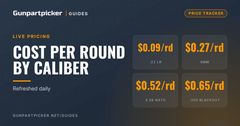 GUIDE/10.08.26Cost Per Round by Caliber
 GUIDE/10.09.26Ammo Price Watch: What to Buy and When
 BARRELS/03.01.26AR-15 Barrel Length Chart: Velocity, Gas and the Best Barrels
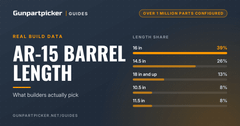 BARRELS/10.01.26AR-15 Barrel Length: What Builders Actually Pick
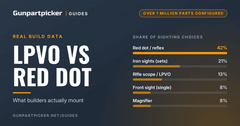 IRON SIGHTS/09.15.26What Builders Actually Mounted in 2026: LPVO vs Red Dot
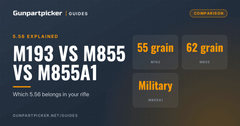 BARRELS/10.05.26M193 vs M855 vs M855A1: Which 5.56 to Buy
 CLONE BUILD/09.16.26CQBR Block I Clone Build Guide: Every Part You Need
 CLONE BUILD/09.18.26Christian Craighead's Nairobi Rifle: The L119A2, Part by Part
Tools for this guide
- Tuning toolTwist Rate CalculatorPick a bullet and a twist rate, get the Miller stability factor, then see barrels with that twist and ammo loaded with that bullet, with today's price per round.
- Planning toolAR Build Cost CalculatorHow much does it cost to build an AR-15? Pick caliber, barrel length, stock or brace and optic, then drag both edges of the price band from the cheap end to the top end. Every slot fills with the part builders add most that is in stock, priced live. The headline total is the core rifle, optics and extras are priced separately, and beside them sits what builders really pay per slot, measured from real part picks. Roll a random build, or open yours in the builder in one click. Computed from over 1 million AR parts selected on GunPartPicker since 2020.
- Legal toolBarrel and Overall Length CheckerEnter barrel length, muzzle device and how the back end is configured, and see whether the build is a rifle, a short barreled rifle, a pistol or an AOW under federal law, with the barrels in stock at that length.