Ammunition is the largest running cost of owning a rifle, and it is the purchase people time worst. Most buy when they run out, which is reliably the most expensive moment.
Where prices sit today
| Metric | Value |
|---|---|
| .22 LR | $0.08/rd |
| 9mm | $0.28/rd |
| 5.56 NATO | $0.51/rd |
| 7.62x39mm | $0.63/rd |
| .300 Blackout | $0.76/rd |
| .308 Win | $1.09/rd |
Cheapest available cost per round alongside the typical figure, refreshed every morning. Our cost per round guide covers what these numbers mean for choosing a cartridge in the first place.
What actually moves ammunition prices
Four things, and they behave differently.
Political events. The sharpest and least predictable driver. Demand spikes on news rather than on any change in supply, and prices move within days while supply takes months to respond. By the time you have decided to buy, the move has usually happened.
Manufacturing and input costs. Slow, broad and permanent. These reset the floor rather than creating spikes.
Seasonal demand. Hunting calibers rise ahead of their seasons. Common range calibers soften in the quieter months.
Component availability. Primers in particular. When primers tighten, everything loaded with them follows, which is why the whole market sometimes moves together for reasons that look unrelated to any specific cartridge.
Timing a bulk purchase
Buy when nothing is happening. Quiet periods are when the cheap end of the market actually exists. It feels like a strange time to spend money, which is exactly why prices are low.
Do not chase a spike. If the price has already jumped, buying reinforces the thing that hurt you. Wait it out unless you genuinely have nothing.
Watch shipping, not just price. Ammunition is heavy and shipping frequently scales with weight. A lower per-round price with expensive shipping is often the worse deal, and free shipping thresholds are a large part of why buying more at once is cheaper per round.
Confirm the load first. Buy a box, shoot it, confirm it runs reliably in your rifle, then buy the case. A case of something your gun does not like is an expensive mistake.
How much to keep
This is a personal decision with two real constraints.
Storage. Ammunition keeps for a very long time somewhere dry and temperature stable. It does badly in a damp garage or anywhere that swings between hot and cold. If you do not have decent storage, solve that before buying in quantity.
Capital. A case is money that does not appreciate. That is fine if you will shoot it, and less fine if it sits as a hedge against something that may not happen.
A reasonable approach is to hold enough that a price spike does not stop you shooting, and to top up during quiet periods rather than buying to a target number.
Practice and defensive ammunition are separate purchases
Worth repeating because it drives the whole strategy.
Practice ammunition should be the cheapest thing that runs reliably and roughly matches your carry load's recoil. Cost per round dominates, so this is what you time and buy in bulk.
Defensive ammunition is bought on performance in small quantities, verified over a couple of hundred rounds, then left alone. Timing it is pointless because you will buy so little.
Our M193 vs M855 guide covers where military ball fits, and where it does not.
Brass, steel and what the saving costs
The cheapest listings in most centrefire calibers are steel cased, and whether that is a good deal depends on what you are doing with it.
It functions reliably in most modern rifles; the old concerns are largely historical. It is dirtier, which means more frequent cleaning and faster fouling in a suppressed gun. It is not reloadable, so if you reload, brass is not really more expensive once you count case life. And a number of ranges prohibit it outright, usually because the cases are magnetic and interfere with brass sorting.
For high-volume practice in a rifle you are not precious about, steel case is a legitimate way to shoot considerably more for the same money. Check your range's rules before buying a case of it, because discovering the policy at the door with 1,000 rounds in the boot is a bad afternoon.
The cheapest practice of all
If your goal is trigger time rather than recoil practice, a rimfire is dramatically cheaper per round than anything centrefire, usually by a wide margin.
Trigger control, sight alignment and position are the same skills regardless of cartridge, and they are the skills that determine whether you hit things. Shooters who improve noticeably tend to shoot both, using rimfire for volume and centrefire for recoil management.
Check before you buy
This page refreshes daily. Look at it before committing to a case rather than reading it once, because the difference between buying well and buying badly on ammunition is larger than almost any other decision on this site.
Filed under5.56 NATO/.300 BLK/.308 Win/Budget Build/Buyer's Guide/Explainer
FAQ
Frequently asked questions
When is the best time to buy ammunition in bulk?
- During quiet periods when nothing newsworthy is happening, which is when the cheap end of the market actually exists. Prices rise fast on events and fall slowly afterwards, so buying during calm is far more valuable than reacting during a spike.
What makes ammunition prices go up?
- Political events cause the sharpest and least predictable spikes, since demand moves on news while supply takes months to respond. Manufacturing costs reset the floor slowly, seasonal demand affects hunting calibers, and component shortages like primers move the whole market.
Does shipping matter when buying ammunition?
- Significantly, because ammunition is heavy and shipping often scales with weight. A lower per-round price with expensive shipping is frequently the worse deal, and free shipping thresholds are a large part of why buying more at once costs less per round.
How much ammunition should I keep?
- Enough that a price spike does not stop you shooting, topped up during quiet periods rather than bought to a target number. The real constraints are dry, temperature-stable storage and the fact that a case is capital that does not appreciate.
Should I buy a case of ammunition I have not tried?
- No. Buy a box, shoot it, confirm it runs reliably in your firearm, then buy the case. A case of something your gun does not like is an expensive mistake and not easily undone.
What is the cheapest way to get trigger time?
- Rimfire, by a wide margin. Trigger control, sight alignment and position are identical skills regardless of cartridge. It does not teach recoil management, so shooters who improve noticeably tend to use rimfire for volume and centrefire for recoil work.
Written by
GPP Editorial TeamAR Build Specialists
GunPartPicker guides are powered by data from real builds. What builders actually select tells the story.
Read next
All guides →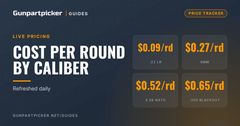 GUIDE/10.08.26Cost Per Round by Caliber
 BARRELS/10.09.26What Calibers AR Builders Actually Choose
 AR-15/10.09.26AR-15 Upgrades by Setup: Pistol, 14.5, 16 Inch, 300 Blackout and Factory Rifles
 LOWER RECEIVERS/09.16.26AR-15 vs AR-10: What Actually Carries Over
 LOWER RECEIVERS/03.30.26What to Buy Before Virginia's Gun Ban
 TRIGGERS/10.06.26Best AR-10 Upgrades 2026: What .308 Builders Actually Pick
 SUPPRESSORS/09.18.26Best 300 Blackout Suppressors in 2026
 AR-15/09.21.26The AR-15 Build Cost Index
Tools for this guide
- Tuning toolTwist Rate CalculatorPick a bullet and a twist rate, get the Miller stability factor, then see barrels with that twist and ammo loaded with that bullet, with today's price per round.
- Planning toolAR Build Cost CalculatorHow much does it cost to build an AR-15? Pick caliber, barrel length, stock or brace and optic, then drag both edges of the price band from the cheap end to the top end. Every slot fills with the part builders add most that is in stock, priced live. The headline total is the core rifle, optics and extras are priced separately, and beside them sits what builders really pay per slot, measured from real part picks. Roll a random build, or open yours in the builder in one click. Computed from over 1 million AR parts selected on GunPartPicker since 2020.