Gun Tools/Tuning/Updated September 15, 2026
Barrel Twist Rate Calculator: Bullet Stability Factor (SG)
Pick a bullet and a twist rate, get the Miller stability factor, then see barrels with that twist and ammo loaded with that bullet, with today's price per round.
Quick answer
- A 77 gr 5.56 NATO bullet at 2700 fps from a 1:8 twist barrel has a Miller stability factor of 1.70: stable.
- The slowest twist that fully stabilizes it (SG 1.5) in these conditions is 1:8.5; 294 5.56 NATO barrels in the GunPartPicker catalog list a 1:8 twist.
Source: GunPartPicker catalog and build data, prices checked September 15, 2026
What twist rate does my bullet need?
Miller stability formula. SG below 1.0 tumbles, 1.0 to 1.4 is marginal, 1.5 and up is fully stable with full ballistic coefficient.
77 gr, 0.224" diameter, 1.00" long
Inches of barrel per one full turn of the rifling. Smaller number, faster twist.
Default 2700 fps for this bullet. Short barrels lose 25 to 50 fps per inch.
Cold, dense air lowers stability. 59 F is the standard atmosphere.
Stability factor (SG)
1.70
Stable
Verdict
Stable
Fully stabilized in normal conditions. SG 1.5 and up is the usual target.
Slowest twist for SG 1.5
1:8.5
in these conditions
Bullet
77 gr
77 gr MatchKing (Mk262 type), 5.56 NATO
Stability factor by twist rate for the 77 gr 5.56 NATO
Same bullet, velocity and temperature, every twist the catalog carries for this bore.
| Twist | SG | Verdict |
|---|---|---|
| 1:5 | 4.36 | Stable with margin |
| 1:6 | 3.03 | Stable with margin |
| 1:7 | 2.23 | Stable with margin |
| 1:7.5 | 1.94 | Stable |
| 1:7.7 | 1.84 | Stable |
| 1:8 | 1.70 | Stable |
| 1:9 | 1.35 | Marginal |
| 1:10 | 1.09 | Marginal |
| 1:12 | 0.76 | Unstable |
| 1:14 | 0.56 | Unstable |
| 1:16 | 0.43 | Unstable |
5.56 NATO barrels with a 1:8 twist
Barrels chambered for this cartridge that list this twist. In stock first, then the ones builders add most.
Ranked by what builders add most, in stock first. One listing per model.


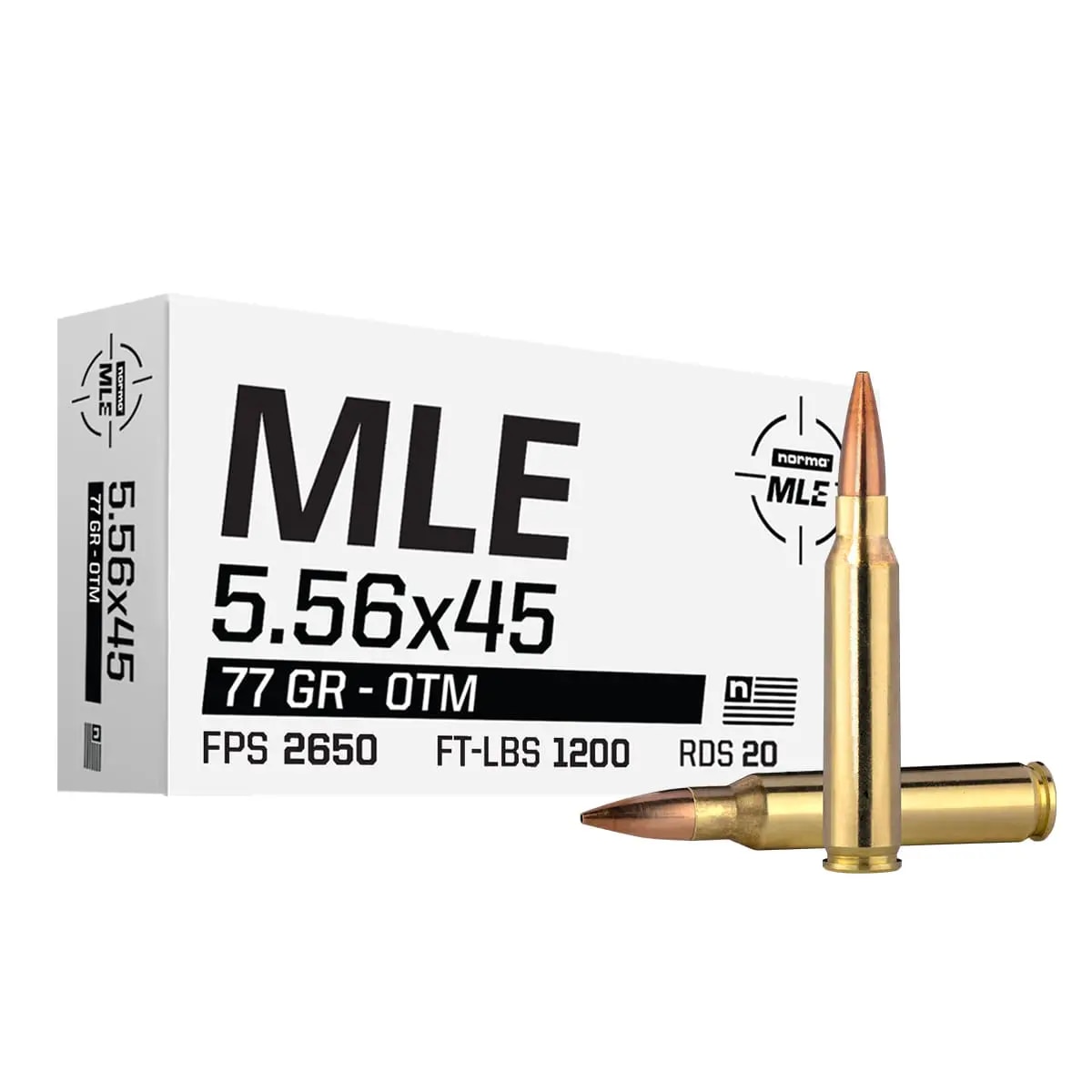
77 grain 5.56 NATO ammo
Loads at this bullet weight, cheapest cost per round first. Best in stock price today: $0.45 per round.
Cheapest cost per round first, in stock first. Box sizes are separate listings.



How barrel twist rate stabilizes a bullet (Miller formula)
A bullet is a spinning top. Spin it fast enough and it flies point first; too slow and air pressure on the nose tips it over. What matters is not weight but length: a long bullet has more nose for the air to push on and needs more spin. That is why the 77 grain MatchKing and the 62 grain M855 need a faster twist than the short 55 grain M193, and why solid copper bullets, which are longer for their weight, need faster twists still.
The Miller formula turns bullet length, diameter, weight, twist, velocity and air density into a single stability factor. Velocity helps a little (cube root), so the same bullet from a 10.5 inch barrel is slightly less stable than from a 20 inch. Cold air hurts: a load at SG 1.3 on a summer afternoon can drop under 1.1 on a winter morning and start to keyhole.
The practical rule for an AR-15 is 1:8 for everything and 1:7 if you shoot 77 grain and heavier. .300 Blackout ships in 1:7 or 1:8 and both stabilize 220 grain subsonics; 1:5 is for the longest 240 grain and heavier loads. For .308 and 6.5 Creedmoor, 1:10 and 1:8 respectively cover the common match bullets.
Twist rate chart by cartridge
| Cartridge | Common twists | Recommendation |
|---|---|---|
| 5.56 NATO / .223 Rem | 1:7, 1:8, 1:9, 1:12 | 1:8 for 40 to 77 gr; 1:7 for 77 gr and up |
| .300 Blackout | 1:5, 1:7, 1:8 | 1:7 standard, 1:8 fine for supers and 220 gr subs; 1:5 for 240 gr and heavier subsonics |
| .308 Win / 7.62x51 | 1:10, 1:11, 1:12 | 1:10 covers 147 to 190 gr; 1:8 for 208 gr and heavier |
| 6.5 Creedmoor | 1:8 | 1:8 for 120 to 147 gr |
| 6mm ARC | 1:7.5 | 1:7.5 for 105 to 108 gr |
| .224 Valkyrie | 1:6.5, 1:7 | 1:7 for 90 gr |
| 7.62x39mm | 1:9.5, 1:10 | 1:10 for 123 gr |
| 9mm | 1:10, 1:16 | Either; 9mm bullets are short and easy to stabilize |
| .22 LR | 1:16 | 1:16 is standard; 1:9 for 60 gr subsonic |
Frequently Asked Questions
What twist rate do I need for 77 grain 5.56?
1:7 or 1:8. Both stabilize the 77 grain MatchKing with margin. 1:9 is marginal and can keyhole in cold weather; 1:12 will not stabilize it at all.
What is a good gyroscopic stability factor?
1.5 or higher is the usual target for full stability and full ballistic coefficient. Between 1.0 and 1.4 the bullet flies point first but with a lower effective BC and a risk of tipping in dense air. Below 1.0 it tumbles.
Is 1:7 or 1:8 better for 5.56?
1:8 handles everything from 40 to 77 grains well and is the better all round choice. 1:7 is the military twist, built for the long M856 tracer, and it stabilizes 77 grain and heavier with more margin. It can overspin very light, thin jacketed varmint bullets at high velocity.
What twist rate does 220 grain subsonic .300 Blackout need?
1:7 is the .300 Blackout standard and stabilizes the 220 grain MatchKing with a stability factor near 2.7 at 1,050 feet per second. 1:8 still clears 2.0. 1:10 drops to about 1.3, marginal, and 1:12 tumbles. 1:5 is for the longest 240 grain and heavier subsonics in cold air, where the low velocity gives the twist nothing to work with.
Can a barrel twist be too fast for a bullet?
Rarely. The practical limit is light, thin jacketed bullets at high velocity, which can come apart from centrifugal force in a very fast twist. For match and FMJ bullets a faster twist costs a small amount of precision and nothing else.
Why is my rifle keyholing?
The bullet is not stable. Either the twist is too slow for the bullet (check the SG above), the velocity is far below what the bullet was designed for, or the crown is damaged. Cold, dense air makes a marginal combination worse.
How accurate is the Miller formula?
Within a few percent for conventional jacketed bullets. It is less accurate for plastic tipped bullets (use the full length including the tip) and for solid copper bullets, which are longer for their weight and need a faster twist than a lead core bullet of the same weight.
Cite this tool: GunPartPicker, “Barrel Twist Rate Calculator: Bullet Stability Factor (SG)”, https://gunpartpicker.net/tools/twist-rate-calculator. Data from the GunPartPicker catalog and real community builds, prices checked September 15, 2026. Free to cite with attribution.
More Gun Tools
- LegalBarrel and Overall Length CheckerEnter barrel length, muzzle device and how the back end is configured, and see whether the build is a rifle, a short barreled rifle, a pistol or an AOW under federal law, with the barrels in stock at that length.
- CompatibilityMuzzle Thread CheckerPick your barrel's caliber and platform, get the standard thread pitch, and see every muzzle device and suppressor in the catalog that actually threads on, with live prices.
- LegalGun Travel CheckerCan I bring my gun to another state? Pick where you start, where you are going and what is coming along: carry pistol, AR-15, magazines, suppressor, SBR, brace, forced reset or binary trigger, hollow points. Every state on the route is checked for transporting firearms across state lines: magazine limits, assault weapon bans, NFA rules, carry permit type and trigger bans, with what to do before the state line.
- PlanningAR Build Cost CalculatorHow much does it cost to build an AR-15? Pick caliber, barrel length, stock or brace, optic and a price tier. Every slot fills with the part builders add most that is in stock, priced live, with the cheapest and median build beside it, real community builds that match, and one click to open it as a named build. Computed from over 1 million AR parts selected on GunPartPicker since 2020.
- CompatibilityFRT and Binary Trigger PickerChoose your platform and see every forced reset trigger, binary trigger and Super Safety the catalog carries for it, what the host needs to run one, and where each is in stock.
- CompatibilityGlock Red Dot Fit CheckerPick how your Glock slide is cut and see which red dots mount directly, which need a plate, and the plates and optics in stock right now.
- TuningBuffer Weight CalculatorEnter your gas system, barrel length, buffer tube and ammo, add a suppressor or a fast trigger, and get the buffer weight to start with plus the buffers in stock that match.