On October 9, 2026, ATF stopped enforcing the rule that made you wait for federal permission before putting a stock on a short barreled AR-15. It did that with an enforcement policy. Congress hasn't repealed anything, the travel rule still stands, and your state's law didn't move at all.
So yes, as far as ATF is concerned, you can build an SBR today without a Form 1. Whether you should, and where, depends on four things the policy leaves in place.
From ATF's October 9, 2026 FAQ, Update to NFA Transfer Guidance
| Metric | Value |
|---|---|
| ATF approval to make an SBR | Not enforced |
| The National Firearms Act | Still law |
| Crossing state lines | Form 20 still |
| Your state's law | Unchanged |
What did ATF actually announce?
ATF published three documents on October 9: a press release, an open letter signed by Director Robert Cekada, and an FAQ titled Update to NFA Transfer Guidance. The FAQ is the one to read. It says the Justice Department "will not enforce the NFA against any person" for the domestic making, possession and transfer of four items: short barreled rifles, short barreled shotguns, suppressors and "any other weapons".
For those four, ATF lists what it stopped enforcing, including:
- Applying for and getting approval before you make one (Form 1)
- Applying for and getting approval before you transfer one (Form 4)
- Registration in the National Firearms Registration and Transfer Record
- The bans on making, receiving or possessing an unregistered one
- The ban on moving an unregistered one across state lines under the NFA
- The NFA's marking requirement
Two NFA bans survive. Possessing one with an obliterated serial number, or one brought into the country illegally, is still enforced.
Why ATF did it
The tax went first. The One Big Beautiful Bill Act cut the tax on making or transferring an SBR from $200 to $0 starting January 1, 2026. The other three items went to $0 too. Then, on August 5, Judge James Wesley Hendrix of the Northern District of Texas ruled in Silencer Shop Foundation v. ATF that a registration scheme built on the taxing power can't survive once there's no tax to collect.
That ruling only protects the people in the case: the plaintiffs, their members and their customers. ATF's FAQ says it extended nonenforcement to everyone else to end the "inequity and disuniformity" of a rule that applied to some buyers and not their neighbors.
How Short Barreled Rifles Got Here
Each entry is a statute, a court filing or an ATF document, coloured by who produced it
- Jul 4, 2025Public recordCongress cuts the tax to $0
The One Big Beautiful Bill Act sets the making and transfer tax on SBRs, SBSs, suppressors and AOWs to $0 from January 1, 2026. Machine guns and destructive devices stay at $200.
- Jan 1, 2026First partyThe $0 tax takes effect
Form 1 and Form 4 still required ATF approval and registration. Only the $200 went away.
- Aug 5, 2026Public recordA Texas federal court rules the $0 item provisions unconstitutional
Silencer Shop Foundation v. ATF, No. 6:25-cv-056 (N.D. Tex.), Judge James Wesley Hendrix. With no tax to collect, the court held, the registration sections no longer rest on Congress's taxing power. The injunction covers only the plaintiffs, their members and customers.
- Aug 12, 2026Public recordThe injunction takes effect
After a seven day stay.
- Oct 1, 2026Public recordDOJ tells the court it won't appeal
In a filing on the docket, the Justice Department says it has notified Congress that it won't take the case to the Fifth Circuit.
- Oct 9, 2026First partyATF stops enforcing for everyone
An open letter signed by Director Robert Cekada, a press release and an FAQ extend nonenforcement to SBRs, SBSs, suppressors and AOWs nationwide, injunction or not.
- Oct 12, 2026Public recordDOJ's answer to nine states is due
Nine plaintiff states asked the court to clarify how far the injunction reaches. The answer could widen or narrow who the court order itself protects.
- Oct 22, 2026Public recordBrown v. ATF status conference
A separate challenge to the NFA's $0 items in the Eastern District of Missouri.
| Date | Event | Source |
|---|---|---|
| Jul 4, 2025 | Congress cuts the tax to $0 | record |
| Jan 1, 2026 | The $0 tax takes effect | official |
| Aug 5, 2026 | A Texas federal court rules the $0 item provisions unconstitutional | record |
| Aug 12, 2026 | The injunction takes effect | record |
| Oct 1, 2026 | DOJ tells the court it won't appeal | record |
| Oct 9, 2026 | ATF stops enforcing for everyone | official |
| Oct 12, 2026 | DOJ's answer to nine states is due | record |
| Oct 22, 2026 | Brown v. ATF status conference | record |
What the October 9 change doesn't touch
Read this part before you order a stock. Each item comes from ATF's own FAQ, and we'd weigh the first two most.
1. The statute is still on the books. ATF gives three examples of how enforcement could restart: Congress adds any tax back, the court's injunction is dissolved or overturned, or the Justice Department rescinds the policy. The NFA still calls an unregistered SBR contraband, and the penalties are felonies.
2. There's no grandfather clause. If enforcement resumes, ATF says federal law "does not generally permit subsequent registration" of an unregistered item. The only way back is an amnesty of up to 90 days, which the Attorney General may hold and isn't required to.
3. Crossing a state line still needs a Form 20. That rule lives in the Gun Control Act, 18 U.S.C. 922(a)(4), which the court never touched. ATF's FAQ says you must file Form 5320.20 before taking an SBR or SBS across state lines "even if it is unregistered". Suppressors and AOWs don't need one.
4. A gun store selling you a complete SBR is a separate rule. Section 922(b)(4) bars a dealer from selling an SBR unless the Attorney General authorizes it. The NFA approval used to satisfy that. ATF says no other approval process exists yet, so it won't enforce 922(b)(4) until it writes one. The 4473 and background check still apply, and a dealer still can't sell you anything your state bans.
Machine guns and destructive devices are outside all of this. The $200 tax and the full NFA still apply to them.
Your state decides most of it
ATF's FAQ is blunt here: "Most states require that individuals who possess NFA items comply with federal law or register them under the National Firearms Act." ATF also says it can't tell you whether an SBR held under its nonenforcement policy counts as lawfully held under your state's statute.
On October 9, the Firearms Policy Coalition wrote to the attorneys general of 15 states whose laws tie NFA items to federal compliance, asking them to stop enforcing those laws. The 15 are:
| Region | States |
|---|---|
| West | Alaska, Colorado, Montana, Nevada, Oregon, Washington |
| Midwest | Michigan, North Dakota, Ohio, Wisconsin |
| South | Georgia, Mississippi, North Carolina |
| Northeast | Connecticut, Pennsylvania |
Montana's attorney general spoke in August, before the national policy: possessing an unregistered silencer is still a state felony there.
A few states ban SBRs outright whatever ATF does. California, Hawaii, New Jersey, New York and Washington, D.C. are consistent across every source we found. Others restrict them in ways that depend on who's reading the statute.
Should you still file a Form 1?
ATF still keeps the registry, still accepts Form 1 and Form 4, and still approves them at $0. Filing is now your choice. We'd file one in three situations:
- You live in one of the 15 states above. A registered SBR is legal there under the old rules and the new ones.
- You might move to one. ATF says federal law generally doesn't let you register one later without an amnesty.
- You want cover if the policy flips. A registered SBR doesn't depend on who runs the Justice Department next year.
If none of that applies, ATF's position is that you can skip it. Don't deregister an SBR you already have, though. ATF will remove it if you email the NFA Division, and once it's off the registry it can't go back on without an amnesty.
A 14.5 inch pin and weld still has a job
A 14.5 inch barrel with a muzzle device pinned and welded to reach 16 inches is a rifle, not an SBR. That's why 14.5 inch uppers take 18% of upper picks, more than any single shorter length. That share held flat after October 9.
The pinned rifle still crosses state lines with no Form 20, and it needs no NFA paperwork in any of the 15 compliance states. If you travel to shoot, or you live somewhere with a registration statute, we'd still build the pinned 14.5. The 14.5 pin and weld guide covers the parts.
Upper Receiver Picks by Barrel Length
Share of upper receiver selections on GunPartPicker, July 1 to September 30, 2026
| Item | Share (%) |
|---|---|
| 16 inch | 37.2% |
| 14.5 inch | 18.3% |
| Under 10 inch | 11.3% |
| 11.5 inch | 10.6% |
| 10.3 to 10.5 inch | 10.4% |
| 17 inch and longer | 8.8% |
| 12.5 inch | 2.7% |
| 13 to 14 inch | 0.6% |
What short builds are picking now
An upper receiver with a short barrel has never been an NFA item on its own. Buying a 10.5 or 11.5 inch upper was always legal federally. What changed is the wait between that upper arriving and a stock going on behind it.
Short barrels have jumped since the announcement. For fourteen straight weeks, barrels and uppers under 14.5 inches held about a third of picks. In the days since October 9 they've taken more than four in ten.
Barrels and uppers under 14.5 inches as a share of all barrel and upper picks on GunPartPicker
| Metric | Value |
|---|---|
| Summer range | 29 to 37% |
| Week of October 5 | 40% |
| October 9 to 12 | 43% |
| 14.5 inch uppers | Unchanged |
If you already have an AR pistol, we'd check the buffer tube before buying a stock. Most pistol tubes are smooth, with no notches for a stock to lock into, so the swap usually needs a carbine receiver extension too. The AR pistol guide covers buffers and springs for short barrels.
10.3 and 10.5 inch: the Mk18 length
The Daniel Defense Mk18 upper leads the shortest common length. It pairs the Mk18's 10.3 inch barrel length with the RIS II quad rail Daniel Defense supplies to USSOCOM. The barrel is cold hammer forged with a 1 in 7 twist, and the upper runs about $1,450.

11.5 inch: the most picked short length
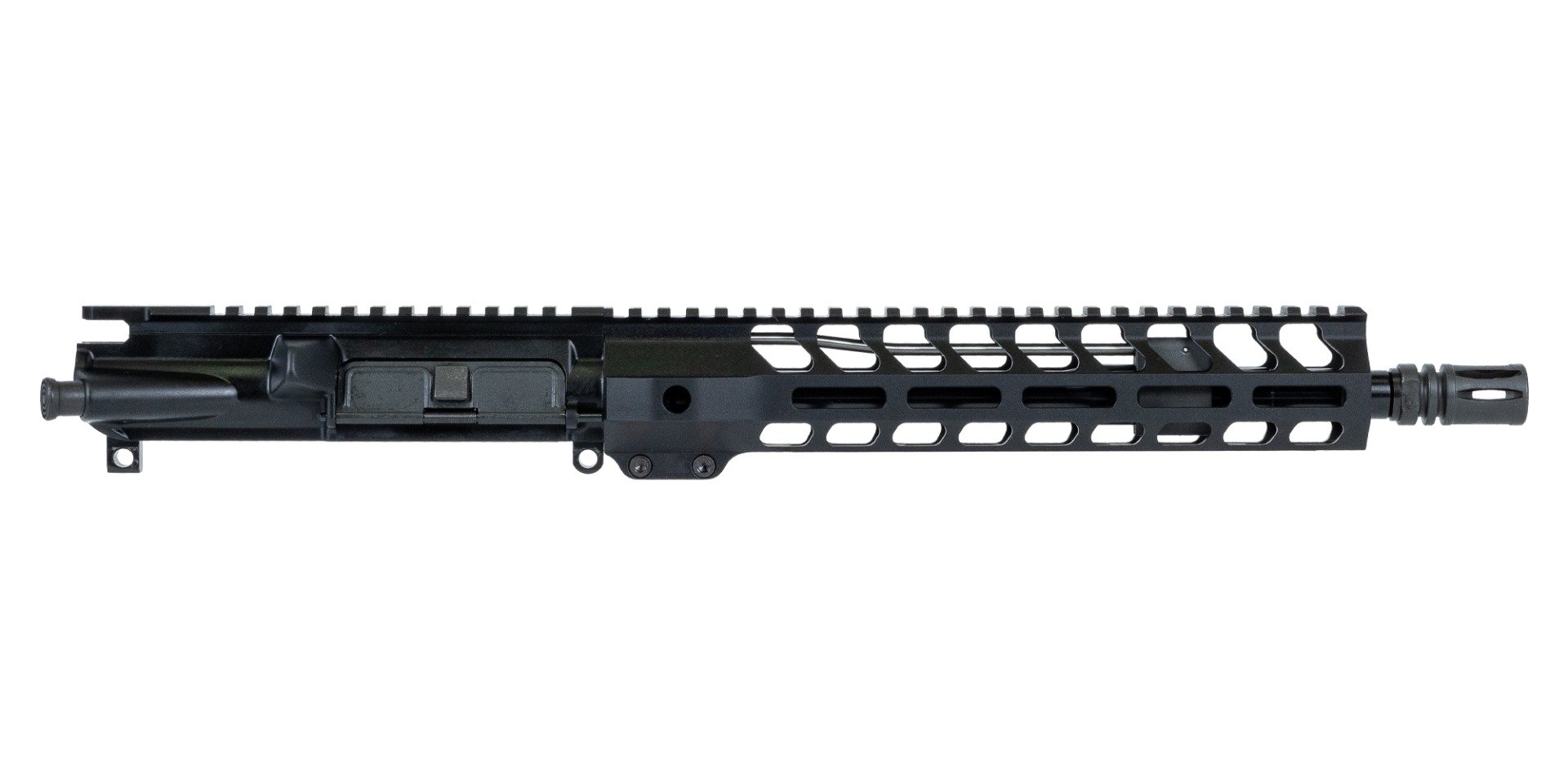
Daniel Defense leads again at 11.5 inches, with about a quarter of picks at that length. Its complete upper runs a 1 in 7 barrel under a 10 inch MFR M-LOK rail, at about $1,280. PSA's 11.5 inch nitride upper is second, at about $230 without a bolt carrier or charging handle.

12.5 inch: the quiet compromise
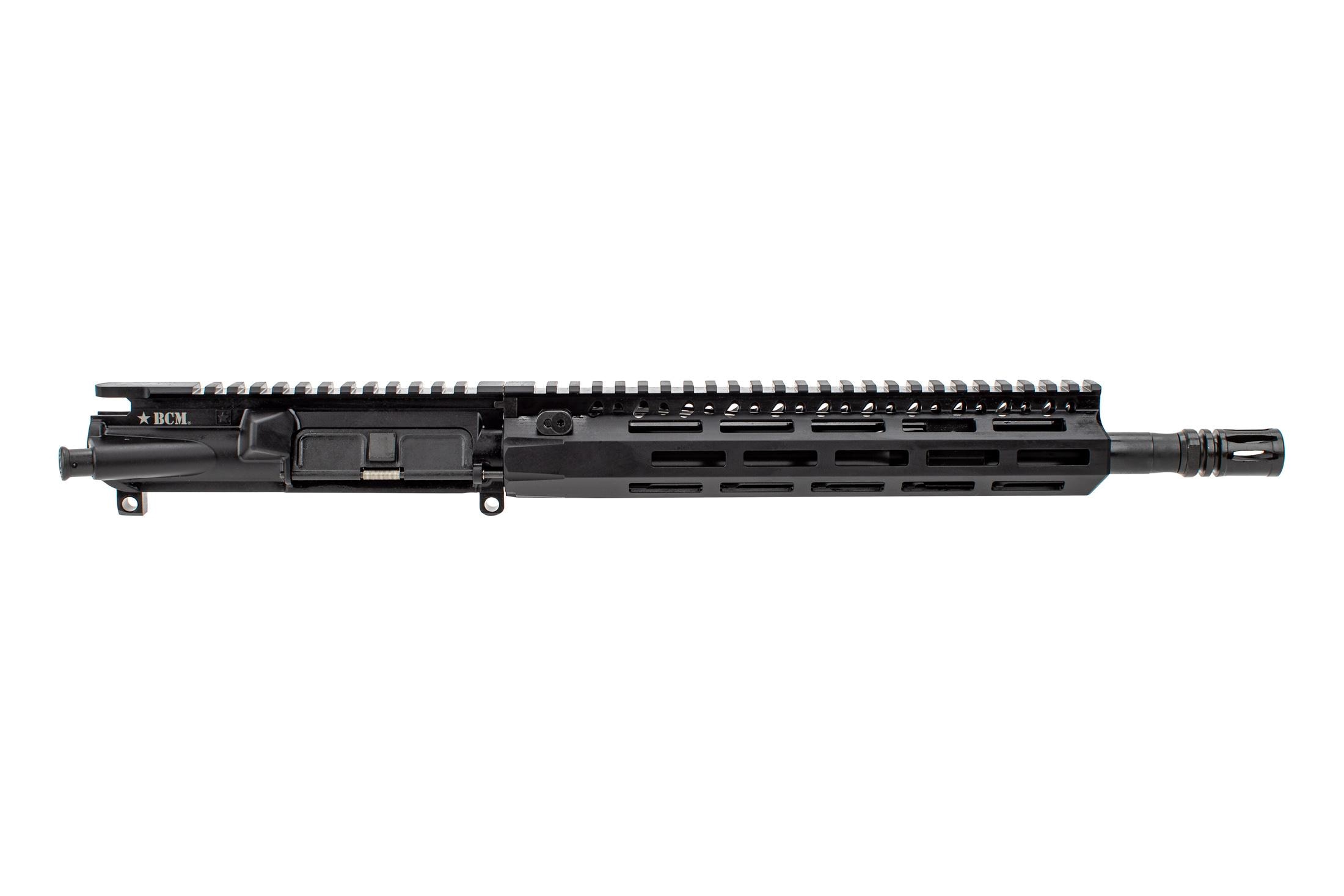
BCM's 12.5 inch upper leads the length that gives up the least velocity, under a 10 inch MCMR rail, at about $775.
What to watch next
- The nine states' motion. Nine plaintiff states asked Judge Hendrix to clarify how far the injunction reaches, and the Justice Department's response was due October 12. A wider injunction would put more people under a court order rather than a policy.
- ATF's dealer forms. ATF says it's drafting a non NFA approval process for dealer SBR sales under 922(b)(4). Expect dealer practice to settle once that exists.
- Brown v. ATF. Another challenge to the $0 items, in the Eastern District of Missouri, has a status conference on October 22.
- Your attorney general. If any of the 15 compliance states answers the FPC letters, we'll update our state pages and this guide.
What to read next
Filed underState Law/FFL Intelligence/AR-15/Upper Receivers/Explainer
FAQ
Frequently asked questions
Are short barreled rifles legal now?
- Federally, yes for now, under an ATF enforcement policy. ATF announced on October 9, 2026 that it would stop enforcing the National Firearms Act's approval, registration and tax stamp requirements for short barreled rifles. The law itself hasn't changed, so the policy can be reversed. State law still decides, and California, Hawaii, New Jersey, New York and Washington, D.C. ban SBRs outright.
Do I need a tax stamp for an SBR in 2026?
- Not under ATF's current policy. The tax has been $0 since January 1, 2026, and since October 9, 2026 ATF says it won't enforce the approval and registration that the stamp used to represent. ATF still approves a Form 1 or Form 4 at $0 if you want the SBR registered, which matters in states whose law expects NFA items to be registered.
Do I still need to file a Form 1 to SBR my AR-15?
- Not under ATF's current policy, though filing one can still be the smart move. ATF's October 9, 2026 FAQ says unlicensed individuals no longer need to file a Form 1 and get approval before making an SBR, and may file one voluntarily. File it anyway if you live in or might move to a state that ties NFA items to federal registration. ATF says federal law generally doesn't allow registering it later unless the Attorney General declares an amnesty.
Can I travel to another state with an SBR?
- Only with an approved ATF Form 5320.20. That requirement comes from the Gun Control Act, 18 U.S.C. 922(a)(4), not the NFA, and ATF's FAQ says it applies even if the SBR is unregistered. The destination state's own law still decides whether you can bring it at all.
Can I buy an SBR from a gun store without a Form 4?
- Yes for now, where your state allows it and the dealer agrees. ATF says it won't enforce 18 U.S.C. 922(b)(4), the rule requiring Attorney General approval for a dealer to sell an SBR, until it writes a replacement for the NFA process. The dealer still runs a Form 4473 and a background check and can't sell in violation of your state's law. ATF still accepts a Form 4 if you want the SBR registered.
Which states still require SBRs to be registered?
- Most of them, by ATF's account: its FAQ says most states require NFA items to comply with federal law or be registered under the NFA. On October 9, 2026, the Firearms Policy Coalition asked the attorneys general of 15 states whose laws tie some NFA items to federal registration to stop enforcing them: Alaska, Colorado, Connecticut, Georgia, Michigan, Mississippi, Montana, Nevada, North Carolina, North Dakota, Ohio, Oregon, Pennsylvania, Washington and Wisconsin. Not every one of those laws names SBRs, so read your own state's statute before relying on any list.
Should I unregister my SBR?
- We wouldn't. ATF will remove an item from the registry if you email its NFA Division, but its FAQ says a removed item can't be registered again unless the Attorney General declares an amnesty. A registered SBR stays legal under the old rules and the new policy, and in states that tie legality to federal registration.
What happens if ATF starts enforcing the NFA again?
- An unregistered SBR would be a federal felony to possess again, and nothing would grandfather it automatically. ATF gives three examples of what could restart enforcement: Congress adds a tax back, the court's injunction is dissolved or overturned, or the Justice Department rescinds the policy. The Attorney General may, but doesn't have to, hold an amnesty of up to 90 days.
Can I put a stock on my AR pistol now?
- Yes, as far as ATF's October 9, 2026 policy goes, though the result is an SBR under the law and every point above applies to it, including state law and the Form 20 for travel. Most AR pistols use a smooth pistol buffer tube, so a stock usually needs a carbine receiver extension as well.
Written by
GPP Editorial TeamAR Build Specialists
GunPartPicker guides are powered by data from real builds. What builders actually select tells the story.
Read next
All guides → STATE LAW/10.01.26Connecticut Glock Ban Blocked: What the Judge's Ruling Does
 STATE LAW/09.30.26CA's New Glock 43X: What We Know
 STATE LAW/10.12.26Short Barreled Shotguns and AOWs After ATF's October 9 Change
 LOWER RECEIVERS/09.23.26Under 21 Handgun Sales: What the DOJ Opinion Changed and What It Did Not
 LOWER RECEIVERS/09.29.26Aero Precision After the Receivership: Did Builders Leave?
 UPPER RECEIVERS/03.02.26Most Popular AR-15 Upper Receivers: Data-Backed 2026 Guide
 LOWER RECEIVERS/09.16.26AR-15 vs AR-10: What Actually Carries Over
 MAGAZINES/09.23.26BCM9: The 9mm Carbine Bravo Company Teased and Never Priced
Tools for this guide
- Legal toolGun Travel CheckerCan I bring my gun to another state? Pick where you start, where you are going and what is coming along: carry pistol, AR-15, magazines, suppressor, SBR, brace, forced reset or binary trigger, hollow points. Every state on the route is checked for transporting firearms across state lines: magazine limits, assault weapon bans, NFA rules, carry permit type and trigger bans, with what to do before the state line.
- Planning toolAR Build Cost CalculatorHow much does it cost to build an AR-15? Pick caliber, barrel length, stock or brace and optic, then drag both edges of the price band from the cheap end to the top end. Every slot fills with the part builders add most that is in stock, priced live. The headline total is the core rifle, optics and extras are priced separately, and beside them sits what builders really pay per slot, measured from real part picks. Roll a random build, or open yours in the builder in one click. Computed from over 1 million AR parts selected on GunPartPicker since 2020.
- Legal toolBarrel and Overall Length CheckerEnter barrel length, muzzle device and how the back end is configured, and see whether the build is a rifle, a short barreled rifle, a pistol or an AOW under federal law, with the barrels in stock at that length.