Cheap and cheaper than usual are different questions, and only the second one helps you time a purchase.
A pistol grip is always cheap. That tells you nothing about whether to buy one today. A barrel that is running below what that same barrel normally costs is actionable.
Today's picture
| Metric | Value |
|---|---|
| Optic Mount | -8% |
| Optic | -7% |
| Trigger | -7% |
| Light | -7% |
| Rifle Scope | -7% |
| Barrel | -4% |
| Handguard | -4% |
| Lower Receiver | -3% |
| Bolt Carrier Group | -3% |
| Upper Receiver | -1% |
Each figure compares the cheapest current in-stock offer for a product against that same product's own median price over the last ninety days, then averages across the category. Negative means the category is currently running below its own recent norm.
Why the method matters
This deserves explaining, because the obvious approach gives nonsense.
Comparing a category's average historical price against its current median produces dramatic numbers that mean nothing, because the two populations are not the same. Products enter and leave the catalogue, listings change, and a category containing both boxes and cases of ammunition will swing wildly for reasons that have nothing to do with pricing.
The first version of this analysis reported one ammunition category as 73% below average. That was not a sale. It was two different sets of things being compared.
Comparing each product against its own history removes that entirely. The numbers get much smaller and much more believable, which is what you want from a signal you intend to spend money on.
How to use it
Buy the categories that are down. If barrels are running below their norm and you need a barrel, that is your signal. The effect is worth real money in the expensive slots and almost nothing in the cheap ones.
Wait on the categories that are up, if you can. Parts pricing mean-reverts, and a category above its own median usually comes back.
Ignore it entirely for small controls. A few percent on a trigger guard is not worth timing. Our build cost index shows where the money actually sits, and it is concentrated in two slots.
What it cannot tell you
Whether an individual product is a bargain. A category average hides everything interesting at product level. A specific barrel can be heavily discounted while its category sits flat.
Whether the price will fall further. This is a snapshot against recent history, not a forecast.
Whether the part is any good. A cheap barrel that is cheap because nobody wants it is not a deal. Our build order analysis covers where quality genuinely matters.
The ninety day window
We use ninety days rather than a year, deliberately.
A longer window sounds more authoritative and is less useful, because it drags in pricing from market conditions that no longer apply. Ninety days is long enough to smooth out weekly noise and short enough that the comparison reflects the market you are actually buying in.
It is also what the underlying data supports well. We would rather publish a shorter window we can stand behind than a longer one we cannot.
Why prices move at all
It helps to know what you are actually watching, because not every dip means the same thing.
Stock arriving. A category fills up, the cheap end reappears, and the average comes down. This is the most common cause and the most reliable to buy into.
Seasonal demand. Optics and ammunition move around hunting seasons. Build parts move around the winter, when people assemble projects indoors.
A new product generation. When a maker replaces a model, the outgoing one discounts. That is frequently the best value on the whole market, because the previous generation is rarely meaningfully worse.
Genuine oversupply. Occasionally a category is simply overstocked and everyone discounts at once. Rare, and worth acting on quickly when it happens.
What you are hoping to avoid is the fifth case: something cheap because it is bad, or because a maker is in trouble and clearing inventory. Price alone cannot distinguish that from a real bargain, which is why this page is a timing tool and not a shopping list.
Combining this with the rest
This page tells you when. Our cheapest complete build guide tells you what it costs, and three builds at today's prices tells you where the tiers differ.
Used together the strategy is straightforward: work out which slots dominate your budget, watch those categories here, and buy them when they dip. Buy everything else whenever convenient, because timing the cheap slots is not worth the attention.
A note on sale prices
The figures use listed in-stock prices. A genuine sale shows up here as the category moving down, which is the point.
What it will not capture is a coupon code, a bundle, or a discount applied at checkout. Those are real savings and they are invisible to a price feed, so treat this as a floor on what is available rather than the best possible outcome.
Filed underAR-15/Barrels/Optics/Budget Build/Buyer's Guide/Explainer
FAQ
Frequently asked questions
How do you calculate whether a part is below its average?
- By comparing the cheapest current in-stock offer for each product against that same product's own median price over the last ninety days, then averaging across the category. Comparing each product to itself avoids the population mismatch that makes category-level comparisons meaningless.
Why are the percentages so small?
- Because single digit movement is the honest scale for category-wide pricing. If a page claims an entire part category is half price, be suspicious of the method. A genuine bargain on one product is invisible inside a category average.
Why ninety days and not a year?
- A longer window sounds more authoritative and is less useful, because it drags in pricing from market conditions that no longer apply. Ninety days smooths weekly noise while still reflecting the market you are actually buying in.
Can this tell me if a specific product is a good deal?
- No. A category average hides everything interesting at product level, so a specific barrel can be heavily discounted while its category sits flat. Use this to decide which categories to shop, then compare individual products.
Should I time every part purchase?
- No, only the expensive ones. A few percent on a trigger guard is not worth the attention, while the same movement on a barrel or upper receiver is real money. Buy small controls whenever convenient.
Does this include coupon codes and sales?
- It uses listed in-stock prices, so a genuine price reduction shows up as the category moving down. Coupon codes, bundles and checkout discounts are invisible to a price feed, so treat these figures as a floor rather than the best available outcome.
Written by
GPP Editorial TeamAR Build Specialists
GunPartPicker guides are powered by data from real builds. What builders actually select tells the story.
Read next
All guides → BARRELS/09.22.26The Cheapest Complete AR-15 You Can Build Right Now
 TRIGGERS/10.07.26PSA PA-15 Upgrades 2026: What PSA Builders Pick First
 CLONE BUILD/09.16.26CQBR Block I Clone Build Guide: Every Part You Need
 CLONE BUILD/09.18.26Christian Craighead's Nairobi Rifle: The L119A2, Part by Part
 CLONE BUILD/09.16.26M4A1 Block I Clone Build Guide: The Standard-Issue SOCOM Carbine
 CLONE BUILD/09.16.26M4A1 URGI Clone Build Guide: The Modern SOCOM Standard
 BARRELS/03.01.26AR-15 Barrel Length Chart: Velocity, Gas and the Best Barrels
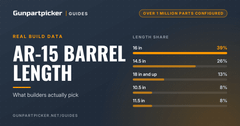 BARRELS/10.01.26AR-15 Barrel Length: What Builders Actually Pick
Tools for this guide
- Planning toolAR Build Cost CalculatorHow much does it cost to build an AR-15? Pick caliber, barrel length, stock or brace and optic, then drag both edges of the price band from the cheap end to the top end. Every slot fills with the part builders add most that is in stock, priced live. The headline total is the core rifle, optics and extras are priced separately, and beside them sits what builders really pay per slot, measured from real part picks. Roll a random build, or open yours in the builder in one click. Computed from over 1 million AR parts selected on GunPartPicker since 2020.
- Legal toolBarrel and Overall Length CheckerEnter barrel length, muzzle device and how the back end is configured, and see whether the build is a rifle, a short barreled rifle, a pistol or an AOW under federal law, with the barrels in stock at that length.
- Compatibility toolGlock Red Dot Fit CheckerPick how your Glock slide is cut and see which red dots mount directly, which need a plate, and the plates and optics in stock right now.