Three builds, the same ten core slots, priced from live in-stock offers and rewritten every morning.
Today's numbers
| Metric | Value |
|---|---|
| Budget | $597 |
| Mid-tier | $1785 |
| Premium | $4573 |
Budget is the cheapest genuinely in-stock offer in each slot. Mid-tier is the typical price. Premium is the upper end of what is actually stocked.
Those are parts totals for a functioning rifle and nothing else. No optic, no sights, no light, no sling, no magazines, no ammunition. Our cheapest complete build guide covers what those add.
Where the money actually goes
The totals are less interesting than the distribution, and the distribution is lopsided.
Most of the gap between budget and premium sits in two slots: the barrel and the upper receiver. Small controls barely move between tiers. A premium pistol grip and a budget pistol grip are separated by pocket change, while barrels span a large multiple.
That concentration is the most useful thing on this page, because it means you do not have to pick a tier and buy it throughout. The sensible build is budget in the slots that barely differ and better in the two that dominate.
What the extra money actually buys
Barrel. Better steel, better finishing, tighter chamber tolerances and more consistent bore dimensions. This is the slot where price and performance correlate most honestly, and where a cheap part costs you accuracy for the life of the rifle.
Bolt carrier group. Proper materials, correct heat treatment, properly staked gas key, and increasingly a magnetic particle inspected bolt. The failure mode of a bad one is the rifle stopping. See our BCG guide.
Trigger. The most noticeable upgrade to shoot and the least load bearing. A premium trigger genuinely improves the experience and does not make the rifle work better.
Handguard. Mostly weight, rigidity and finish quality. A cheap free-float rail and an expensive one both free-float the barrel.
Receivers. Largely fit and finish above a certain point. A budget forged lower from a reputable maker is functionally the same as an expensive one.
What it does not buy
Reliability, beyond a certain threshold. A correctly specified budget build runs. The premium version runs too, and not noticeably more.
Accuracy you can use. Above a decent barrel, gains are real and measurable from a rest, and smaller than the difference your position and trigger control make.
Durability that matters at civilian round counts. Most premium durability advantages show up at round counts most owners will never reach.
The build we would actually recommend
Take the mid-tier figure, then move money around inside it.
Buy a good barrel and a good bolt carrier group, which means spending above the median in those two slots. Buy budget small controls, because they can be upgraded at any time with no disruption. Buy a mid-range trigger, which is the best value comfort upgrade on the platform.
That rifle costs close to the mid-tier total and is meaningfully better than a build that spent evenly.
Where complete assemblies change the maths
The premium figure runs high partly because the upper receiver slot includes complete uppers, which bundle a barrel, bolt carrier group and handguard into one line item.
That is worth knowing rather than treating as a quirk, because a complete upper is often the better buy at the top of the market. Headspacing is done, the barrel nut is torqued correctly, and the parts are matched by somebody who does it daily.
At the budget end the opposite tends to hold: assembling from separates gives you control over the two slots that matter and lets you avoid a manufacturer's compromise on the barrel.
So the practical reading is that budget builds reward buying parts, and premium builds reward buying assemblies. The middle is where it genuinely depends on whether you own the tools and want the experience.
Spend the difference elsewhere
The thing most likely to improve your shooting is not on this chart.
A rifle at the budget total with a decent optic, a light, a sling, good magazines and several thousand rounds of ammunition will make you a better shooter than a premium rifle with iron sights and a box of ammunition. That is not a close call.
Our build order analysis shows people consistently over-invest in the parts they touch and under-invest in the parts that determine whether the rifle works, and the same instinct pushes money into the rifle when it should go into ammunition.
How to use this page
Check it before buying the two slots that matter, because those are the ones that move. Barrels and uppers swing with stock levels, and timing those two well is worth more than optimising every small part combined.
Filed underAR-15/Budget Build/Premium Build/Buyer's Guide/Explainer
FAQ
Frequently asked questions
How much does a mid-tier AR-15 build cost?
- The figures on this page come from live in-stock offers and refresh every morning, so they track the current market. Budget is the cheapest in-stock offer per slot, mid-tier the typical price, and premium the upper end of what is stocked.
Where is the price difference between build tiers?
- Mostly two slots: the barrel and the upper receiver. Small controls barely differ between tiers, while barrels span a large multiple. That means you do not have to buy one tier throughout.
Is a premium AR-15 build worth it?
- In the barrel and bolt carrier group, yes, those correlate honestly with price. Elsewhere the gains are small. A correctly specified budget build runs reliably, and most premium durability advantages appear at round counts most owners never reach.
What is the best way to allocate an AR-15 budget?
- Spend above the median on the barrel and bolt carrier group, buy budget small controls since they upgrade later with no disruption, and take a mid-range trigger. That lands near the mid-tier total and beats spending evenly.
Should I spend more on the rifle or on ammunition?
- Ammunition, for most people. A budget rifle with a decent optic, light, sling, good magazines and several thousand rounds will make you a better shooter than a premium rifle with iron sights and one box. That is not a close call.
Does a more expensive AR-15 shoot better?
- Measurably from a rest, above a decent barrel, and by less than your position and trigger control contribute. Accuracy gains from spending more are real but smaller than most buyers expect once you are past a competent barrel.
Written by
GPP Editorial TeamAR Build Specialists
GunPartPicker guides are powered by data from real builds. What builders actually select tells the story.
Read next
All guides →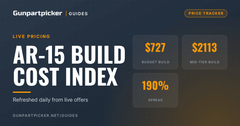 AR-15/09.21.26The AR-15 Build Cost Index
 LOWER RECEIVERS/10.06.26The Parts Builders Pick First
 AR-15/03.16.26What Do You Wish You Knew Before Buying Your First AR-15?
 AR-15/03.22.26GunPartPicker: A PCPartPicker for Guns
 BARRELS/10.07.26Which AR-15 Parts Are Below Their Recent Average
 GUIDE/10.08.26Cost Per Round by Caliber
 GUIDE/10.09.26Ammo Price Watch: What to Buy and When
 AR-15/10.09.26AR-15 Upgrades by Setup: Pistol, 14.5, 16 Inch, 300 Blackout and Factory Rifles
Tools for this guide
- Planning toolAR Build Cost CalculatorHow much does it cost to build an AR-15? Pick caliber, barrel length, stock or brace and optic, then drag both edges of the price band from the cheap end to the top end. Every slot fills with the part builders add most that is in stock, priced live. The headline total is the core rifle, optics and extras are priced separately, and beside them sits what builders really pay per slot, measured from real part picks. Roll a random build, or open yours in the builder in one click. Computed from over 1 million AR parts selected on GunPartPicker since 2020.
- Paint planner toolGun Paint PlannerRattle can guns online before you spray. Paint, stencil and camo a real photo of over 400 guns: AR-15s, AR-10s, AR-9s, AKs, every Glock, pistols, shotguns and bolt action rifles, the way the rattlecanned guns on r/rattlecannedguns are done, with Krylon, Rust-Oleum, Aluma-Hyde, DuraCoat and Cerakote colors, then get the cans to buy in spray order.
- Legal toolGun Travel CheckerCan I bring my gun to another state? Pick where you start, where you are going and what is coming along: carry pistol, AR-15, magazines, suppressor, SBR, brace, forced reset or binary trigger, hollow points. Every state on the route is checked for transporting firearms across state lines: magazine limits, assault weapon bans, NFA rules, carry permit type and trigger bans, with what to do before the state line.