The rifles carried in the bank robbery sequence in Heat are about as plain as an AR gets. An 11.5 inch barrel, a carry handle with iron sights, plastic handguards, a collapsible stock. No optic. No rail. No light. No sling to speak of.
Thirty years on, the sequence is still the reference point for firearms handling on film. The rifles make a good build precisely because they've got nothing on them.
| Metric | Value |
|---|---|
| Barrel | 11.5 in |
| Sights | Carry handle |
| What it teaches | Fundamentals |
The barrel
11.5 inches. In 1995 that was an unusual, slightly exotic configuration, and today it's a well supported standard. It's short enough to work in vehicles and around corners, and long enough to avoid the worst of the velocity loss and blast below 10 inches.
Our barrel length data puts 11.5 inch as a small but consistent share of what builders select. You get most of the handling benefit of a 10.3 inch upper with a slightly better reliability margin and noticeably less blast.

Iron sights only
Take this part seriously rather than treating it as period flavour.
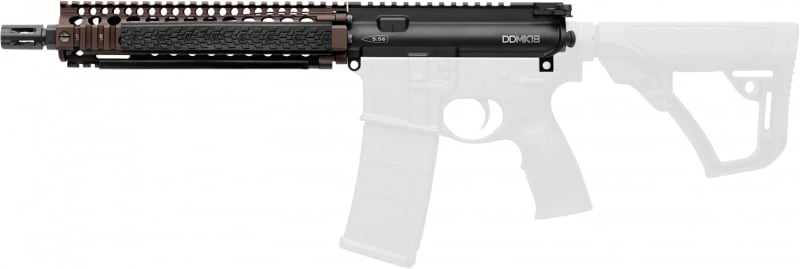
A carry handle puts the rear aperture high above the bore and gives you a sight radius that runs nearly the length of the receiver. Irons are slower to acquire than a red dot. They demand a consistent cheek weld, because a sloppy head position moves your eye relative to the aperture and the shot goes with it.
So shoot them. A red dot forgives head position and irons don't. Spend a few hundred rounds behind a carry handle and your position gets consistent, because the rifle punishes you when it isn't.
Our iron sights guide covers the modern options if you want the discipline without the carry handle.
The handguards
Plain plastic carbine handguards, still made and still inexpensive. They don't free float, so you give up a little accuracy, and they get hot faster than you'd expect on a short barrel.
They also weigh almost nothing. People forget that advantage once they've bolted four accessories to a rail.
If you want the silhouette without the drawbacks, a slim free-float M-LOK rail in a similar length gets close and lets you add a light later. Our M-LOK data covers the standards.
What to leave off
The discipline of this build is in what you don't add.
No light is the one criticism of the configuration we'd defend. Identifying your target isn't optional, and a period build can't do it. If this rifle is for anything beyond range use and appearance, add a light and accept the anachronism.
No optic is a legitimate choice at the distances this rifle is for. The front post and the rear aperture in the carry handle still let you zero it properly.
No sling is the easiest thing to fix and the one we'd fix first. A sling is how you carry a rifle when your hands are busy, and adding one changes nothing about the look.
Building it: honest or usable
Same decision as any period clone.
Honest means the carry handle, plastic handguards and nothing added. It looks right, it shoots fine at the distances it's for, and it makes a good training rifle because nothing compensates for you.
Usable keeps the 11.5 inch barrel and the general shape but adds a free-float rail, a light and a low-mounted red dot. You get a better rifle and a worse clone.
Decide up front, because the handguard makes the two incompatible.
Why we like this build
Most clone builds are about equipment. This one is about the absence of it.
If you've built modern ARs with an optic, a light, a laser and a sling, assembling something with none of that is a useful corrective. You'll shoot it worse at first. You'll also find out quickly which of your skills belong to you and which belong to your accessories.
The same era's military carbines are in our Black Hawk Down build, and the M4A1 Block I clone build shows what the pattern became once rails and optics arrived.
Filed underIron Sights/Clone Build/AR-15/5.56 NATO/CQB/Build Guide
FAQ
Frequently asked questions
What rifles were used in Heat?
- Short-barrelled Colt carbines in the 11.5 inch class with carry handles, iron sights and plain plastic handguards. No optics, rails, lights or slings. Film armouries vary between scenes, so treat any parts list as inspired-by rather than documented.
Is an 11.5 inch barrel a good length?
- It sits in a sensible place: most of the handling benefit of a 10.3 inch upper with a slightly better reliability margin and meaningfully less blast and velocity loss. It is a small but consistent share of what builders select today.
Are iron sights worth learning on an AR-15?
- Yes. A red dot is forgiving of head position and irons are not, so shooting behind a carry handle forces a consistent cheek weld. A few hundred rounds of it improves your position in a way a red dot never will.
Should I build a period-correct or usable version?
- Decide before buying, since the handguard makes them incompatible. Period-correct looks right and is a good training rifle because nothing compensates for you. Usable keeps the barrel and silhouette but adds a free-float rail, light and red dot.
What is the biggest weakness of this configuration?
- No light. Identifying what you are pointing at is not optional, and a period build cannot do it. If the rifle is for anything beyond range use and appearance, add a light and accept the anachronism.
Is an 11.5 inch AR-15 legal?
- It depends on configuration and jurisdiction. Under federal law a barrel under 16 inches makes it a short-barrelled rifle unless built as a pistol, SBRs are separately regulated, and some states prohibit them entirely. Verify before building.
Written by
GPP Editorial TeamAR Build Specialists
GunPartPicker guides are powered by data from real builds. What builders actually select tells the story.
Read next
All guides → CLONE BUILD/10.15.26Black Hawk Down build: the Ranger and Delta carbines on screen
 CLONE BUILD/10.14.2613 Hours Build: The Contractor Carbine
 CLONE BUILD/10.14.26Act of Valor build: the Bandito Platoon SEAL carbine
 CLONE BUILD/09.16.26CQBR Block I Clone Build Guide: Every Part You Need
 CLONE BUILD/09.16.26CQBR Block II Clone Build Guide: The Daniel Defense Upgrade
 CLONE BUILD/09.18.26Christian Craighead's Nairobi Rifle: The L119A2, Part by Part
 CLONE BUILD/09.16.26Mk18 Mod 0 Clone Build Guide: The Original CQB Weapon System
 CLONE BUILD/09.16.26Sicario Task Force Build: The Parts List
Tools for this guide
- Legal toolGun Travel CheckerCan I bring my gun to another state? Pick where you start, where you are going and what is coming along: carry pistol, AR-15, magazines, suppressor, SBR, brace, forced reset or binary trigger, hollow points. Every state on the route is checked for transporting firearms across state lines: magazine limits, assault weapon bans, NFA rules, carry permit type and trigger bans, with what to do before the state line.
- Planning toolAR Build Cost CalculatorHow much does it cost to build an AR-15? Pick caliber, barrel length, stock or brace and optic, then drag both edges of the price band from the cheap end to the top end. Every slot fills with the part builders add most that is in stock, priced live. The headline total is the core rifle, optics and extras are priced separately, and beside them sits what builders really pay per slot, measured from real part picks. Roll a random build, or open yours in the builder in one click. Computed from over 1 million AR parts selected on GunPartPicker since 2020.
- Legal toolBarrel and Overall Length CheckerEnter barrel length, muzzle device and how the back end is configured, and see whether the build is a rifle, a short barreled rifle, a pistol or an AOW under federal law, with the barrels in stock at that length.