Most screen references need heavy caveats, because film armories dress rifles for the camera. This one needs fewer.
Act of Valor was made with active-duty SEALs carrying their own issued equipment. The rifles you see in Bandito Platoon's hands are much closer to what was in service at the time than to what looked good on screen.
| Metric | Value |
|---|---|
| Upper | 10.3 in class |
| Rail | Quad, period correct |
| Why it matters | Real equipment |
The short carbine the SEALs carry on screen
The rifles are Mk18 pattern: a 10.3 inch upper on a standard lower, built for working in vehicles, boats, aircraft and buildings.
By the time the film was shot, the configuration had settled after a decade of refinement. You get a short barrel, carbine gas, a rail with room for the accessories the job needed, and a non-magnified optic.
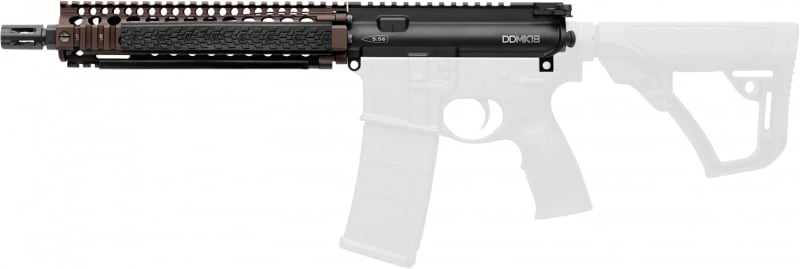

If you want the issued rifle part by part, our Mk18 Mod 0 clone build covers the military base configuration, and the CQBR Block I clone build covers the upper that came before it.
The rail is the period marker
The rail dates the build more than anything else, so get it right if authenticity matters to you.
These rifles wear quad rails, because the film predates M-LOK taking over. Every accessory bolted to 1913 rail sections. You paid in weight and sharp edges and got the ability to mount anything anywhere.
Our handguard data shows quad rails still taking a meaningful share of selections today, and clone builds are most of the reason.
If you want the silhouette without the weight, a modern M-LOK rail of similar length is the practical substitute. You'll lose the period look and save about a pound. Decide which you're building before you buy, because the rail makes them incompatible.
Light and laser, both
The accessory load is the other period marker.
A white light, for identification. Non-negotiable then and now.
An infrared laser, because the work was largely done under night vision. As our Zero Dark Thirty build explains, under goggles the laser becomes the primary aiming solution and the optic becomes the daylight backup.
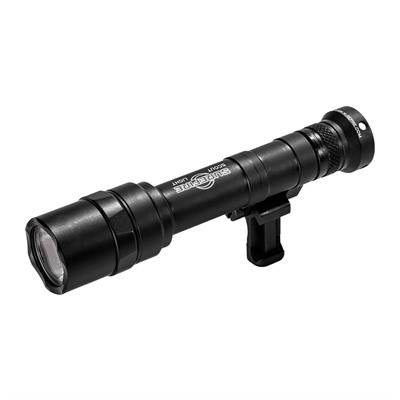

On a civilian build, the laser only makes sense if you own night vision. Without it, you're mounting weight that does nothing.
Optic
Non-magnified, mounted low, with night vision compatible brightness settings if you plan to run it under goggles. Our LPVO versus red dot data shows builders overwhelmingly choose a red dot anyway.
The rest of the loadout matters here
Because the equipment was genuine, what's hanging off the shooter teaches you as much as what's in their hands.
Plate carriers sit high and tight, cut so the rifle can be shouldered without the stock fouling the armour. A carrier that rides low looks fine standing still. It becomes a problem the moment you go prone or work around a vehicle.
Magazines sit where a seated person can reach them, further forward and higher than most people set up when they buy a rig at a bench.
Slings are adjustable and get adjusted: loose to move, short to shoot. Nobody sets them once and leaves them.
None of that's expensive, and all of it does more for how usable a rifle is than another accessory on the rail. Plenty of people spend heavily on the gun and then carry it badly.
Why we like this build
Two reasons.
It's a genuine snapshot. The equipment was real and in service, so the configuration shows you what a decade of institutional refinement converged on, not what somebody thought looked capable.
It shows you the cost of the era. Quad rails are heavy. Mounting everything on 1913 means bulk. Build one and carry it for an afternoon, and you'll understand why M-LOK won better than any article can explain it.
The practical version
If you want the capability rather than the period appearance, start with a 10.3 or 11.5 inch upper and a slim free-float M-LOK rail. Add a quality red dot mounted low, a light positioned for your thumb, and an adjustable gas block, because you'll want to suppress it.
You'll have a better rifle by every measure except authenticity. With the suppressor tax now at zero, the suppressed version is easier to get than it was.
Filed underClone Build/AR-15/5.56 NATO/Lights/Lasers/CQB/Build Guide
FAQ
Frequently asked questions
Were real weapons used in Act of Valor?
- The film was made with active-duty personnel carrying their own issued equipment, which makes the rifles unusually representative of what was actually in service rather than dressed for camera. Individual rifles still differed, so treat any parts list as inspired-by.
What rifles are in Act of Valor?
- Mk18-pattern carbines: a 10.3 inch upper on a standard lower, with a quad rail, a white light, an infrared laser and a non-magnified optic. It represents the configuration after roughly a decade of institutional refinement.
Why do these rifles use quad rails instead of M-LOK?
- Because the era predates M-LOK displacing everything. Accessories bolted to 1913 rail sections, which meant weight and sharp edges in exchange for mounting anything anywhere. Quad rails still take a meaningful share of selections today, largely from clone builds.
Do I need an infrared laser for this build?
- Only if you own night vision. The laser exists because the work was done under goggles, where it becomes the primary aiming solution and the optic becomes the daylight backup. Without night vision it is weight that does nothing.
Should I build the period version or a practical one?
- Decide before buying, because the rail makes them incompatible. Period-correct uses a quad rail and looks right at roughly a pound more weight. The practical version uses a slim M-LOK rail and is better by every measure except authenticity.
Is a 10.3 inch AR-15 legal?
- It depends on configuration and jurisdiction. Under federal law a barrel under 16 inches makes it a short-barrelled rifle unless built as a pistol, SBRs are separately regulated, and some states prohibit them entirely. Verify before building.
Written by
GPP Editorial TeamAR Build Specialists
GunPartPicker guides are powered by data from real builds. What builders actually select tells the story.
Read next
All guides → CLONE BUILD/10.14.2613 Hours Build: The Contractor Carbine
 CLONE BUILD/10.15.26Black Hawk Down build: the Ranger and Delta carbines on screen
 CLONE BUILD/09.16.26CQBR Block I Clone Build Guide: Every Part You Need
 CLONE BUILD/09.16.26CQBR Block II Clone Build Guide: The Daniel Defense Upgrade
 CLONE BUILD/10.15.26Heat Build: The Colt 733 From the Bank Shootout
 CLONE BUILD/09.18.26Christian Craighead's Nairobi Rifle: The L119A2, Part by Part
 CLONE BUILD/09.16.26Mk18 Mod 0 Clone Build Guide: The Original CQB Weapon System
 CLONE BUILD/09.16.26Sicario Task Force Build: The Parts List
Tools for this guide
- Legal toolGun Travel CheckerCan I bring my gun to another state? Pick where you start, where you are going and what is coming along: carry pistol, AR-15, magazines, suppressor, SBR, brace, forced reset or binary trigger, hollow points. Every state on the route is checked for transporting firearms across state lines: magazine limits, assault weapon bans, NFA rules, carry permit type and trigger bans, with what to do before the state line.
- Planning toolAR Build Cost CalculatorHow much does it cost to build an AR-15? Pick caliber, barrel length, stock or brace and optic, then drag both edges of the price band from the cheap end to the top end. Every slot fills with the part builders add most that is in stock, priced live. The headline total is the core rifle, optics and extras are priced separately, and beside them sits what builders really pay per slot, measured from real part picks. Roll a random build, or open yours in the builder in one click. Computed from over 1 million AR parts selected on GunPartPicker since 2020.
- Legal toolBarrel and Overall Length CheckerEnter barrel length, muzzle device and how the back end is configured, and see whether the build is a rifle, a short barreled rifle, a pistol or an AOW under federal law, with the barrels in stock at that length.