The tax stamp gets the complaints, but the photographs and fingerprint cards are what make people give up. They mean a trip to a law enforcement agency and a passport photo booth, and the whole routine again for every responsible person on a trust.
ATF has proposed cutting that down. The proposal came out on July 6, 2026 under docket ATF-2026-0397, and the comment window closed on October 5, 2026.
Where the Rule Actually Is
Federal Register record, docket ATF-2026-0397
- Jul 6, 2026Public recordProposed rule published
ATF publishes the notice of proposed rulemaking in the Federal Register under docket ATF-2026-0397.
- Oct 5, 2026Public recordPublic comment window closed
Comments are in. ATF decides whether to publish a final rule.
- Oct 9, 2026First partyATF stops enforcing suppressor and SBR registration
Form 1 and Form 4 become optional for suppressors, SBRs, SBSs and AOWs.
- Not scheduledPublic recordFinal rule
ATF must read the comments and publish a final rule before anything changes. There is no published date for this, and a proposal can be withdrawn.
| Date | Event | Source |
|---|---|---|
| Jul 6, 2026 | Proposed rule published | record |
| Oct 5, 2026 | Public comment window closed | record |
| Oct 9, 2026 | ATF stops enforcing suppressor and SBR registration | official |
| Not scheduled | Final rule | record |
What would the proposal change?
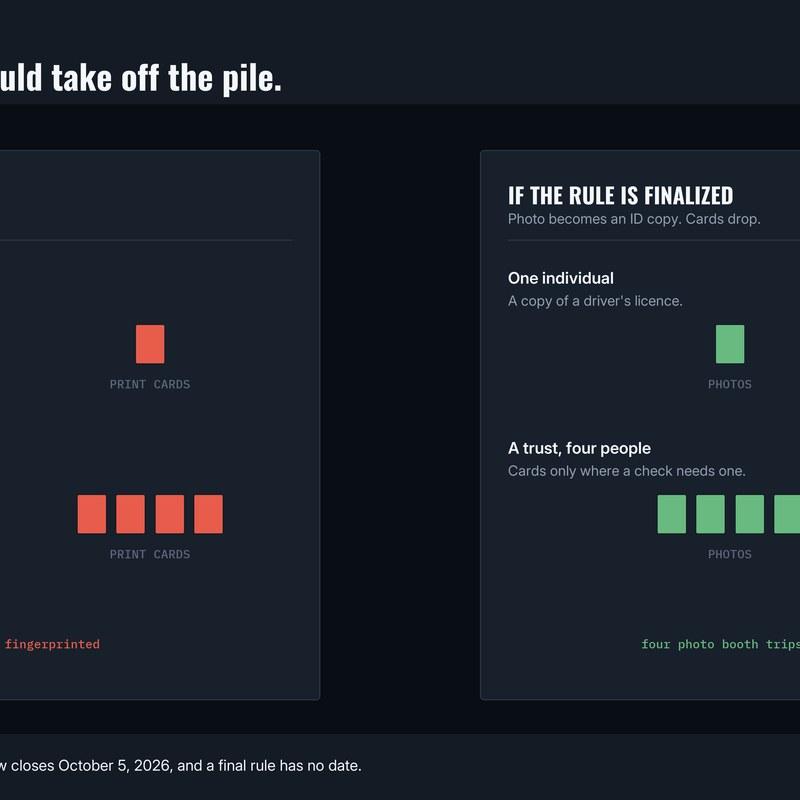
The individual barely notices. A four person trust is where the paperwork actually falls away.
Two things, and both are paperwork rather than law.
Photographs. Today you send a two inch by two inch passport style photograph. Under the proposal you'd send a copy of a photo ID instead. In practice that's a copy of your driver's licence, not a trip to a photo booth.
Fingerprint cards. Individuals, and responsible persons under the Gun Control Act, would send a single fingerprint card. Responsible persons under the National Firearms Act, the trust and corporation case, would send one only where ATF needs it to finish a background check.
Proposed, not adopted. Current requirements still apply.
| Metric | Value |
|---|---|
| Photographs | Photo ID copy |
| Individual prints | One card |
| NFA trust RPs | Only if needed |
| Status | Proposal |
Trusts gain the most. A trust with four responsible persons files a set of cards and photographs for each of them today. That's four fingerprint visits and four photo sessions, and the proposal would cut most of them.
What doesn't it change?
Proposals like this get reported as though Congress had amended the National Firearms Act. This one doesn't change which items are regulated or who may own them. It only changes the identity documents you attach.
Registration changed separately. On October 9, 2026 ATF stopped enforcing it for suppressors, SBRs, SBSs and AOWs, and that was an enforcement decision, not part of this rule.
The proposal also doesn't decide whether you need a Form 4 at all. For suppressors the federal answer is now no, and suppressors in 2026: $0 tax, and no Form 4 since October 9 has the details.
When will there be a final rule?
Comments closed on October 5, 2026. ATF now reads them and decides whether to publish a final rule, and it hasn't given a date.
Buying a suppressor now
Since October 9, 2026, a dealer can sell you a suppressor on a Form 4473 and a background check, with no Form 4, where your state allows it. You might still file a Form 4 because your state ties legality to federal registration, or because you want a record in case the policy is reversed. In a state like that, we'd file. Either way, today's photo and fingerprint rules apply to the form.
In stock prices measured across our merchant feeds on September 17, 2026
| Metric | Value |
|---|---|
| Median price | $800 |
| Cheapest in stock | $104 |
| Most expensive | $3,119 |
| Builds with a suppressor | 2% |
In stock suppressors run from about $100 for a rimfire can to over $3,000, and the middle of the market sits near $800. They show up in about 2 percent of configured builds. With the Form 4 gone, that's the share we'd watch.
Rifle cans

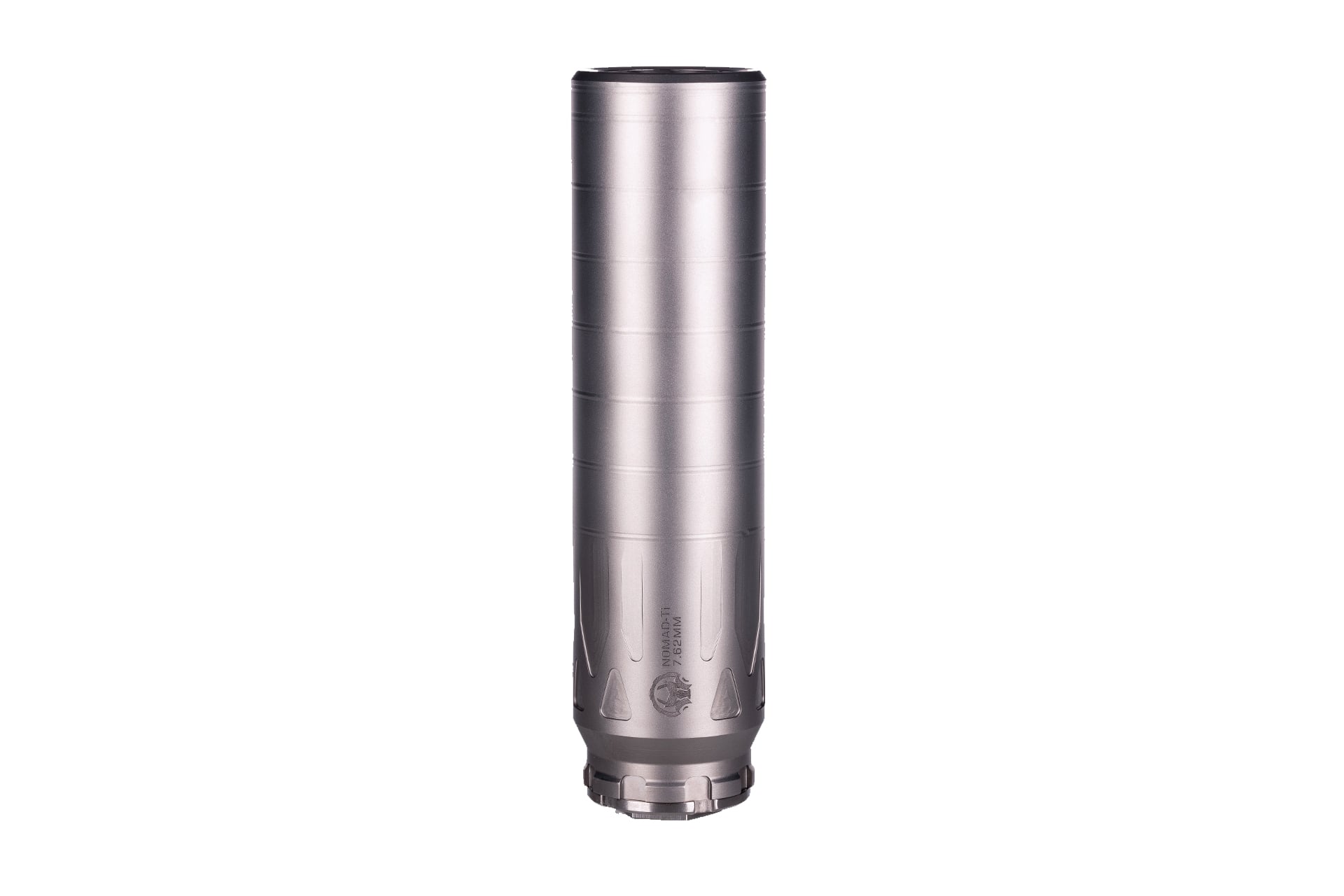

We'd start with a .30 caliber can that mounts by direct thread. It covers 5.56, 300 Blackout and .308 on one suppressor, so it's the most flexible first can for most people. If you're choosing for one cartridge, best 5.56 suppressors and best 300 Blackout suppressors go deeper.
The rifle side of the problem
The can is only half the purchase. It raises back pressure and changes how the rifle cycles, and a handguard that was fine unsuppressed can be too narrow for a can to tuck inside.

Our suppressor ready handguards guide covers inner diameter and tucked cans. Most people measure that too late.
What to watch for
Only a final rule in the Federal Register changes the form requirements. With registration now optional for suppressors, SBRs, SBSs and AOWs, that matters most if you register anyway, or if you own machine guns or destructive devices, where the full NFA process still applies.
The bigger question is whether the October 9 policy holds. Congress could bring back a tax, a court could overturn the ruling, or the Justice Department could rescind its guidance. ATF says nothing would grandfather an unregistered item automatically if that happens.
Filed underState Law/Suppressors/Suppressed/Explainer
FAQ
Frequently asked questions
Has the ATF changed the fingerprint and photo requirements for NFA applications?
- No. It's a proposed rule, published on July 6, 2026 under docket ATF-2026-0397. Every current photograph and fingerprint requirement still applies to any NFA application until a final rule is published. Separately, since October 9, 2026 a Form 1 or Form 4 is optional for suppressors, SBRs, SBSs and AOWs.
When is the comment deadline for the ATF fingerprint and photograph rule?
- It was October 5, 2026, and the comment window is now closed. ATF hasn't published a date for a final rule.
What exactly would change if the rule is adopted?
- Applicants would be able to submit a copy of a photo identification document instead of a two inch by two inch passport style photograph. Individuals and Gun Control Act responsible persons would submit one fingerprint card, and National Firearms Act responsible persons would submit one card only where a background check requires it.
Does this proposal remove the suppressor registration or background check?
- No. The proposal only concerns the identity documents attached to an application. Registration changed separately: on October 9, 2026 ATF stopped enforcing it for suppressors, SBRs, SBSs and AOWs. The dealer background check still applies.
Should I wait to buy a suppressor until the rule is final?
- No need. Since October 9, 2026, a suppressor no longer needs a Form 4 federally, so this rule doesn't affect a dealer purchase. It only matters if you choose to file a Form 4 anyway.
Why does this proposal matter more for trusts than for individuals?
- A trust generates a set of fingerprint cards and photographs for every responsible person. That's a separate law enforcement visit and photo session for each. Reducing the requirement to one card, and only where a check needs it, removes most of that overhead from a multi person trust.
Written by
GPP Editorial TeamAR Build Specialists
GunPartPicker guides are powered by data from real builds. What builders actually select tells the story.
Read next
All guides → STATE LAW/09.23.26Suppressors in 2026: $0 Tax, and No Form 4 Since October 9
 BARRELS/10.19.26338 ARC Explained
 STATE LAW/11.04.26Will the 2026 Midterms Move Gun Sales? What Changes for Buyers
 BARRELS/10.15.26300 Blackout vs 5.56: Which One Belongs in Your Build
 SUPPRESSORS/09.18.26Best .22 LR Suppressors in 2026
 SUPPRESSORS/09.18.26Best 300 Blackout Suppressors in 2026
 SUPPRESSORS/09.17.26Best 5.56 Suppressors in 2026
 BARRELS/10.12.26Best Glock Barrels: Threaded, Match and Stock
Tools for this guide
- Legal toolSBR Planner (3D)Set the barrel anywhere from 7.5 to 16 inches, put a stock, a brace or a folder on the back, pin a muzzle device or slide on a can. The ruler under the rifle shows whether you've cleared the 16 inch barrel line and the 26 inch overall line. Pick your state for its SBR, suppressor and assault weapon rules, then price every part and open the build in one click.
- Legal toolBarrel and Overall Length CheckerEnter barrel length, muzzle device and how the back end is configured, and see whether the build is a rifle, a short barreled rifle, a pistol or an AOW under federal law, with the barrels in stock at that length.
- Legal toolGun Travel CheckerCan I bring my gun to another state? Pick where you start, where you are going and what is coming along: carry pistol, AR-15, magazines, suppressor, SBR, brace, forced reset or binary trigger, hollow points. Every state on the route is checked for transporting firearms across state lines: magazine limits, assault weapon bans, NFA rules, carry permit type and trigger bans, with what to do before the state line.