What an FRT actually does, what your rifle needs to run one, and how the legal picture stands right now
Best AR-15 Forced Reset Triggers in 2026
This guide is informational and is not legal advice. Forced reset triggers have been the subject of active federal litigation and changing agency positions, and a number of states ban them outright regardless of federal posture. Verify the current law in your state, and the current federal position, before you buy or install anything.
What a forced reset trigger actually does
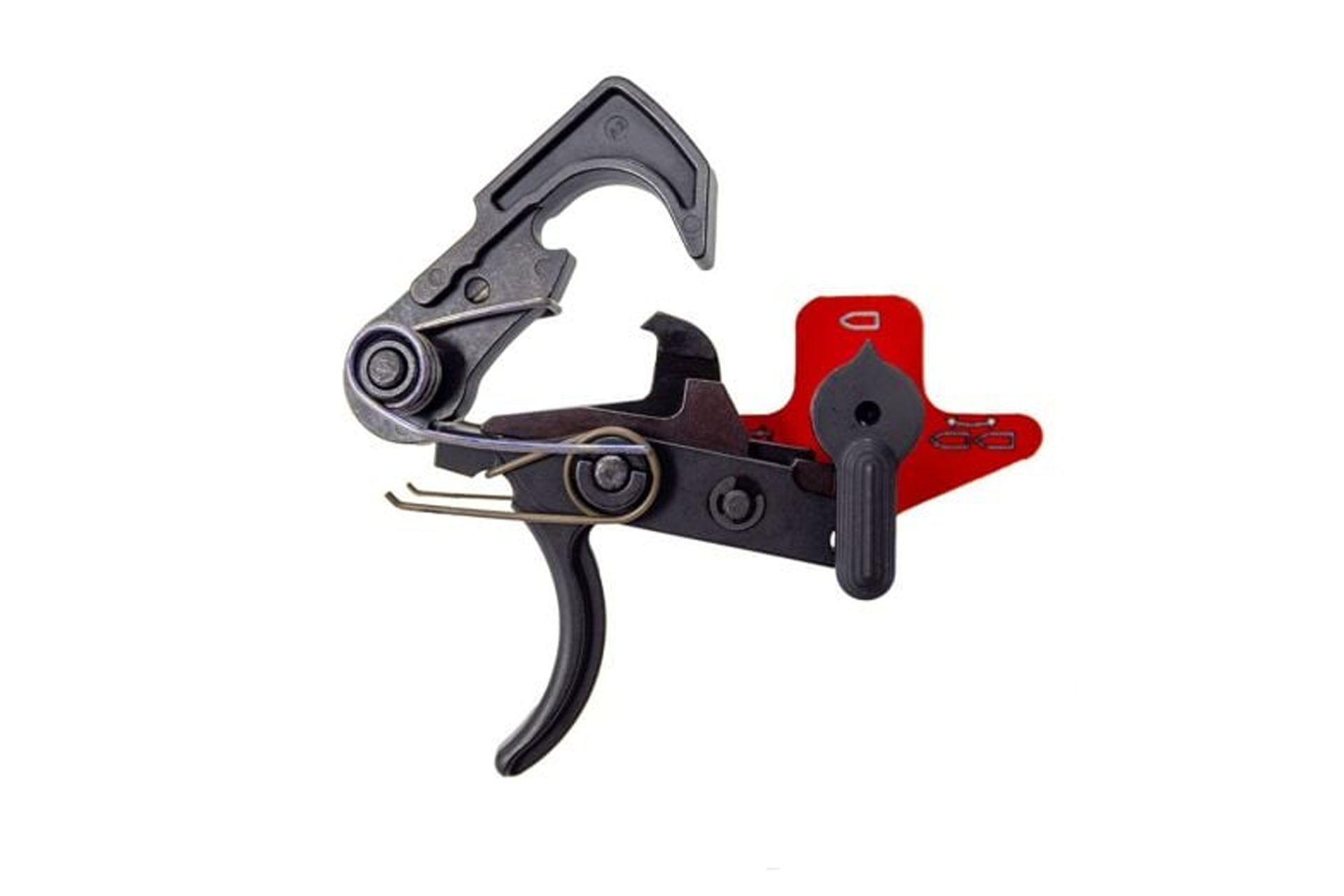
A forced reset trigger is still a semi-automatic trigger. One round leaves the barrel for each function of the trigger. What the device changes is the reset: instead of waiting for you to release the trigger, a surface driven by the bolt carrier pushes the trigger forward against your finger. Your finger is already applying rearward pressure, so the trigger returns to the wall and breaks again far faster than a human can deliberately release and re-press.
That is the whole mechanism, and it is why the host rifle matters more than the brand on the box.
Why the host matters more than the device
An FRT depends on the bolt carrier travelling fast enough, and far enough, to drive the reset every single cycle. Anything that slows or shortens carrier travel breaks it.
That puts three parts ahead of the trigger itself on your shopping list:
- Gas. An undergassed carbine is the single most common reason an FRT runs badly. Short barrels with restrictive gas ports and long dwell suffer most. An adjustable gas block is the usual fix, and it is worth buying before the trigger.
- Buffer and spring. Buffer weight sets how hard and how fast the carrier returns. Too heavy and the reset is sluggish and inconsistent, too light and the rifle beats itself up. Several manufacturers sell buffers specifically for high cycle rate use.
- Bolt carrier group. A full-mass carrier with a clean, square rear face gives the reset surface something consistent to work against.
Across the builds configured on GunPartPicker, the people running high cycle rate triggers change their buffer and gas setup far more often than the average builder does. That is not a coincidence. The trigger is the part you notice, the gas system is the part that decides whether it works.
| Metric | Value |
|---|---|
| Hardest part to get right | The host |
| Most common failure | Short stroke |
| Legal status | In flux |
FRT versus binary versus super safety
These three get used interchangeably and they are not the same thing.
A forced reset trigger mechanically pushes the trigger forward. One round per function of the trigger, much faster reset.
A binary trigger fires one round when you pull and a second when you release. Two rounds per complete trigger cycle, and almost every binary device has a selectable mode that returns it to normal semi-automatic. Binary triggers are the more widely available of the two and are legal in more places.
A super safety is a drop-in selector-style device that achieves a forced reset effect without replacing the fire control group.
If you want the fast-shooting experience with the least legal friction and the widest retailer availability, a binary trigger is usually the more practical purchase.
What to look at when comparing devices
- Selector behaviour. Does the device give you a genuine disengaged semi-automatic mode, and does the safety work normally in every position?
- Host compatibility. Some devices are sold per platform. A device cut for an AR-15 lower will not drop into a roller-delayed or pistol-caliber host.
- Installation. Drop-in cassettes are far easier to live with than anything requiring fitting, and easier to reverse if you sell the rifle.
- Support and revisions. This category revises hardware frequently. Buying from a maker that is still shipping and still answering the phone matters more here than in most part categories.
Binary triggers that are actually in stock
The binary market is the one you can reliably buy from today. These are the AR-pattern options currently carried by the retailers we track:



Parts to buy alongside it
Budget for these at the same time, not later. A fast trigger on a marginal host is a frustrating rifle.
Living with one
Round count climbs fast, and so does wear. The parts that go first are the buffer, the action spring, the gas rings and the trigger group itself, so shorten your inspection interval accordingly rather than running a normal maintenance schedule.
Ammunition choice matters more than people expect. Underpowered or heavily fouling range ammo will drop cycle speed enough to make a marginal setup inconsistent, which is often misdiagnosed as a faulty trigger. If the rifle starts running badly, confirm with known-good ammunition before you change parts.
Finally, be realistic about where you can shoot it. A large number of ranges prohibit rapid fire outright, and that restriction applies whether the rate comes from a device or from your finger.
The legal picture, honestly
The federal position on forced reset triggers moved more than once across 2025 and 2026, and there is active litigation between manufacturers over patents as well as ongoing argument about agency authority. Separately, a number of states ban forced reset and binary devices under their own statutes, and a state ban applies to you regardless of what the federal position is that month.
We are not going to pretend that is settled. Check your own state's current statute, and check the current federal posture, before you spend money. If you are in a state with a feature-based rifle ban, assume these devices are prohibited unless you have confirmed otherwise.
Frequently Asked Questions
GPP Editorial Team
AR Build Specialists
GunPartPicker guides are powered by data from real builds — what builders actually select tells the story.
Related Guides
Tools for this guide
- Compatibility toolFRT and Binary Trigger PickerChoose your platform and see every forced reset trigger, binary trigger and Super Safety the catalog carries for it, what the host needs to run one, and where each is in stock.
- Legal toolGun Travel CheckerCan I bring my gun to another state? Pick where you start, where you are going and what is coming along: carry pistol, AR-15, magazines, suppressor, SBR, brace, forced reset or binary trigger, hollow points. Every state on the route is checked for transporting firearms across state lines: magazine limits, assault weapon bans, NFA rules, carry permit type and trigger bans, with what to do before the state line.