Start with the important caveat
The 2025 federal settlement that resolved much of the forced reset question for rifles carried a specific condition worth understanding here: Rare Breed agreed not to produce or market forced reset triggers for handguns where the magazine loads into the grip.
That is essentially every Glock-pattern pistol. The same agreement expressly leaves room for pistols where the magazine sits ahead of the grip, such as AR and AK pattern pistols, which is why that end of the market is far better supplied.
So the largest and most prominent maker in this space is, by agreement, not in the Glock market. Anything you find is coming from elsewhere, which changes the risk calculation considerably compared to the rifle category.
| Metric | Value |
|---|---|
| Category size | Small |
| Settlement | Carve-out |
| State law | Decisive |
Why pistols are harder
The rifle version works because an AR-15's bolt carrier travels a long way with substantial momentum, giving the reset mechanism plenty of energy and time to work with.
A Glock slide travels a much shorter distance, much faster, with far less mass. There is simply less to work with, and the tolerances involved are tighter.
That has two consequences. The engineering is genuinely harder, which is part of why the category is small. And reliability is more sensitive to ammunition, recoil spring condition and how clean the pistol is than the rifle equivalent.
Reliability considerations
If you are evaluating one, these are the variables that matter.
Recoil spring condition. A tired spring changes slide velocity and timing, which is exactly what the mechanism depends on. Springs are consumables on any pistol and more so here.
Ammunition. Weaker loads produce less slide velocity. A device that runs on one load may be inconsistent on another, more so than a conventional trigger would be.
Cleanliness. Tighter mechanical tolerances mean fouling matters more.
Generation and model fit. Glock fire control geometry differs between generations, and Gen 5 in particular is not compatible with earlier parts. Confirm exact fit before ordering, which is the most common mistake in any Glock trigger purchase. See our Glock triggers guide.
What is actually available
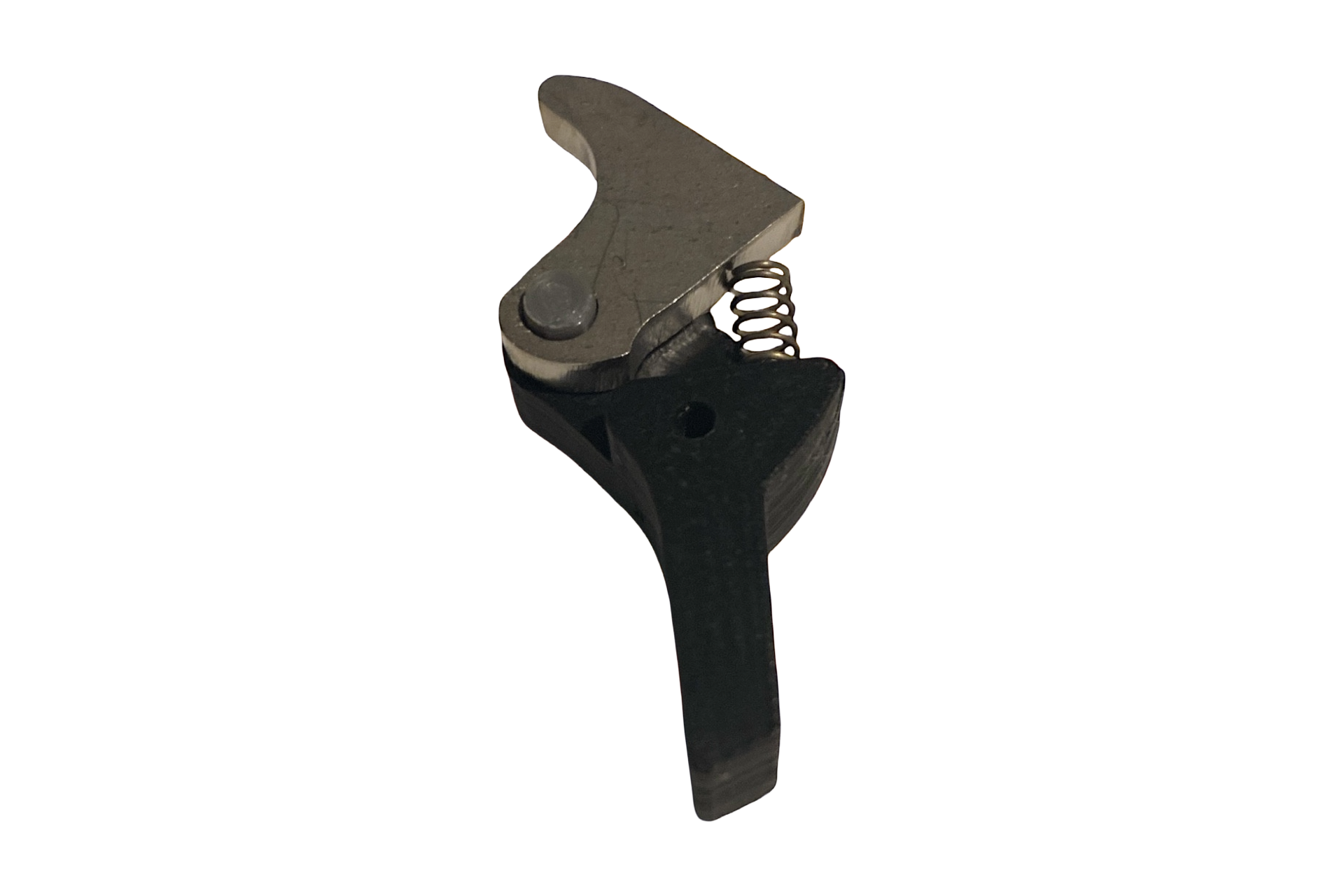
With the largest maker out of this market, what you will find comes from smaller companies. A few sell forced reset kits for Glock-pattern pistols. Before ordering, confirm the exact generation it fits, check your state law, and read the next section before deciding this belongs on a pistol you carry.

Out of stock
The safety dimension is different on a pistol
This deserves saying plainly rather than being left implied.
A pistol is drawn from a holster, carried on the body, and handled at close quarters far more often than a rifle. A device that increases rate of fire on a platform used that way raises the consequences of any handling error.
If you fit one, treat the pistol as a range gun. Do not carry it. The combination of increased rate of fire and holster work is not one we would take on, and the trigger coverage rules in our holster guide exist precisely because striker-fired pistols are unforgiving of anything entering the trigger guard.
State law is the decisive question
Fifteen states and the District of Columbia restrict this device category, generally through trigger activator or rate-of-fire statutes that never use the phrase forced reset trigger.
Those statutes reach the device regardless of what platform it fits. A Glock device is not treated more leniently than a rifle one, and in some wordings the pistol context is treated more severely.
Check your state before anything else. Our state guide covers the statutory language to search for.
Do not confuse these with conversion devices
This needs stating explicitly because the two get conflated constantly, including by people selling things.
A forced reset trigger requires a function of the trigger for each round fired. A pistol converter, sometimes called a switch or an auto sear, does not: it makes the pistol fire continuously from a single trigger function. That is a machine gun conversion and it is a serious federal felony, with no state where it is lawful for an ordinary owner.
Those devices are also precisely what Maryland and Connecticut legislated against this year, by restricting the pistols they attach to.
If anything is marketed to you as making a Glock fire automatically, or arrives from overseas as a small machined block, it is not a trigger and it is not a grey area. Walk away.
What we would actually do
For most people, this is a category to pass on.
The options are few, the largest maker is contractually absent, the engineering is harder than the rifle equivalent, the tuning options are minimal, and the platform is one you may carry. That is a lot of friction for a range novelty.
If you want the fast-shooting experience, a binary trigger on a rifle is more available, more tolerant of the host, and legal in more places. If you want to shoot a Glock faster, a red dot, a decent trigger and deliberate practice will do more for your actual speed than any device, and they work everywhere.
Filed underState Law/Glock/Triggers/Buyer's Guide/Explainer
FAQ
Frequently asked questions
Are there forced reset triggers for Glocks?
- Some exist, but the category is far smaller than the AR-15 equivalent. The 2025 federal settlement included an agreement by Rare Breed not to produce or market these for handguns where the magazine loads into the grip, which covers essentially every Glock-pattern pistol.
Why are pistol forced reset triggers less common?
- A Glock slide travels a much shorter distance, faster, with far less mass than an AR-15 bolt carrier, so there is less energy and time for the mechanism to work with. The engineering is harder and reliability is more sensitive to ammunition and spring condition.
Can I tune a Glock to run a forced reset device?
- Barely. On a rifle you can adjust gas and buffer weight. On a striker-fired pistol your options are recoil spring weight and ammunition choice, and that is about it. Less adjustability means less margin for reliability.
Are Glock forced reset triggers legal?
- Federally the device category was largely settled in 2025, but fifteen states and DC restrict it through trigger activator or rate-of-fire statutes that never use the phrase. Those reach the device regardless of platform. Check your state first.
Should I carry a pistol with a forced reset trigger?
- We would not. A pistol is drawn from a holster and handled at close quarters far more than a rifle, and increasing rate of fire raises the consequences of any handling error. Treat a pistol fitted with one as a range gun only.
What is a better way to shoot a Glock faster?
- A red dot, a trigger that suits you, and deliberate practice. Those improve your actual speed more than any device, work in every jurisdiction, and carry none of the reliability or legal friction.
Written by
GPP Editorial TeamAR Build Specialists
GunPartPicker guides are powered by data from real builds — what builders actually select tells the story.
Read next
All guides → STATE LAW/09.17.26AK Forced Reset Triggers: The 2026 Field
 STATE LAW/09.16.26Forced Reset Triggers by State: How to Check Yours
 STATE LAW/09.17.26Glock Chassis and PDW Kits: What to Know Before You Buy
 HOLSTERS/09.21.26Glock Gen6: Which Models Come Next, and What Fits Now
 TRIGGERS/09.16.26Best Glock Triggers in 2026
 HOLSTERS/09.22.26Glock 19 Upgrades: What Is Worth It and What Is Not
 MAGAZINES/09.23.26Glock 43X and 48 Upgrades: The Slimline Parts That Actually Fit
 HOLSTERS/09.21.26Ruger RXM Upgrades: Which Glock Parts Actually Fit
Tools for this guide
- Compatibility toolFRT and Binary Trigger PickerChoose your platform and see every forced reset trigger, binary trigger and Super Safety the catalog carries for it, what the host needs to run one, and where each is in stock.
- Legal toolGun Travel CheckerCan I bring my gun to another state? Pick where you start, where you are going and what is coming along: carry pistol, AR-15, magazines, suppressor, SBR, brace, forced reset or binary trigger, hollow points. Every state on the route is checked for transporting firearms across state lines: magazine limits, assault weapon bans, NFA rules, carry permit type and trigger bans, with what to do before the state line.
- Legal toolBarrel and Overall Length CheckerEnter barrel length, muzzle device and how the back end is configured, and see whether the build is a rifle, a short barreled rifle, a pistol or an AOW under federal law, with the barrels in stock at that length.