Holsters are the largest accessory category on the Glock platform by a very wide margin, and the overwhelming majority of that choice is noise. Most people buy two or three before they find one they actually carry, which is an expensive way to learn.
Here is what separates the two.
| Metric | Value |
|---|---|
| Buy first | A real belt |
| Non-negotiable | Trigger coverage |
| Ignore | One-size-fits-all |
The belt is the real decision
This is the thing nobody wants to hear because the belt is the boring purchase.
A holster transfers the weight and the leverage of a pistol into your belt. A soft belt folds, sags and lets the pistol rotate away from your body, which is exactly what makes carrying uncomfortable and what makes a gun print. No holster fixes a bad belt.
A proper gun belt is stiff through its whole length, usually a reinforced leather or a polymer-cored nylon design. It will feel excessively rigid when you first put it on and you will stop noticing within a day.
If your budget only stretches to one good thing, make it the belt.
Trigger coverage is not negotiable
A Glock has no manual safety. The trigger safety only prevents the trigger moving without direct rearward pressure, so anything that presses the trigger will fire the pistol.
That makes one rule absolute: the holster must fully and rigidly cover the trigger guard, and nothing must be able to enter it while the gun is holstered.
Buy a holster made for your exact model and generation. "Fits most Glocks" means it fits none of them correctly.
IWB versus OWB
Inside the waistband holds the pistol between your body and your trousers. It conceals far better because the body of the gun sits inside your waistline, and the only part that has to hide is the grip. It is less comfortable, it requires trousers about two inches larger in the waist, and it gets warm.
Outside the waistband is more comfortable, faster to draw from, and easier to put on and take off. It requires a proper cover garment to conceal and is the better choice for range use, open carry and duty.
Most people carrying a full-size Glock daily end up with IWB, appendix or strong side. Most people who shoot a lot own an OWB for the range as well.
The three adjustments that matter
- Ride height. How high the pistol sits relative to your belt. Higher conceals the grip better and can be harder to get a full firing grip on at the draw.
- Cant. The angle. Forward cant helps conceal the grip under a garment when carrying behind the hip. Neutral suits appendix carry.
- Retention. Enough that the pistol stays put when you move, loose enough that the draw is not a fight. Adjustable retention screws are worth having.
A holster without adjustment is a holster you have to hope fits your body.
What about a light or an optic
If your pistol wears a weapon light, the holster must be cut for that specific light. Light-bearing holsters are not interchangeable between light models.
Optics are easier: most current holsters are cut to clear a red dot, but confirm before buying, especially for an enclosed emitter sight which sits taller. See our Glock optic plates guide for the mounting side.
Holsters worth looking at
Duty and OWB:


IWB and carry packages:
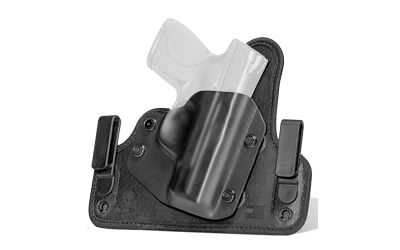

Kydex, leather or hybrid
Kydex is the default for good reason. It is rigid, so it holds its shape when the pistol is out and reholstering stays a one-handed operation. Retention is adjustable and consistent, and it does not care about sweat.
Leather is more comfortable against the body and quieter, and a good one moulds to you over time. It also softens with age and sweat, which eventually compromises the rigid trigger coverage that matters most. Leather holsters are consumables on a longer timescale than most people assume.
Hybrid designs put a kydex shell on a leather or neoprene backer, aiming for kydex retention with a softer surface against the skin. They work well for many people, though the backer can curl over time.
For a carry gun our preference is kydex, or a hybrid with a genuinely rigid shell.
What to skip
- Universal or one-size holsters. Poor retention, poor trigger coverage.
- Soft nylon without a rigid mouth. It collapses when you draw, so reholstering becomes a one-handed fumble in exactly the situation where you want it to be simple.
- Pocket carry a full-size Glock. It does not work. A pocket holster is for small pistols.
- Anything that requires you to unthread your belt to remove it, unless you never take it off.
The short version
Buy a stiff belt first. Buy a rigid holster moulded for your exact model, with a fully covered trigger guard and adjustable retention and cant. Try a cheap one in a new carry position before buying an expensive one. Then practise drawing and, more importantly, reholstering slowly.
Filed underGlock/Holsters/Home Defense/Buyer's Guide
FAQ
Frequently asked questions
What is the most important part of carrying a Glock?
- The belt. A holster transfers the pistol's weight and leverage into your belt, and a soft belt sags and lets the gun rotate away from your body, which causes both discomfort and printing. No holster compensates for a bad belt.
Does a Glock holster need to cover the trigger?
- Completely and rigidly, with nothing able to enter the trigger guard while holstered. A Glock has no manual safety and the trigger safety only stops the trigger moving without direct rearward pressure, so anything that presses the trigger will fire the pistol.
Is IWB or OWB better for a Glock?
- IWB conceals far better because only the grip has to hide, at the cost of comfort and needing larger trousers. OWB is more comfortable and faster to draw from but needs a proper cover garment. Many people who shoot regularly own both.
Are universal holsters safe?
- They are best avoided. A holster that fits many pistols fits none of them correctly, which compromises both retention and trigger coverage. Buy one moulded for your exact model and generation.
Do I need a special holster for a weapon light?
- Yes, and it must be cut for your specific light model, since light-bearing holsters are not interchangeable between lights. Optics are more forgiving, though enclosed emitter sights sit taller so confirm clearance before buying.
Why do people end up with unused holsters?
- Usually because the holster was bought for a carry position they never actually tried rather than because it was badly made. Buying an inexpensive holster to test a new position before committing to a custom one saves money.
Written by
GPP Editorial TeamAR Build Specialists
GunPartPicker guides are powered by data from real builds. What builders actually select tells the story.
Read next
All guides → HOLSTERS/10.02.26Glock 17 vs 19 vs 45: Which Size to Buy
 MAGAZINES/10.06.26Best Glock Magazines and Basepads
 TRIGGERS/09.16.26Best Glock Triggers in 2026
 HOLSTERS/09.22.26Glock 19 Upgrades: What Is Worth It and What Is Not
 HOLSTERS/09.21.26Ruger RXM Upgrades: Which Glock Parts Actually Fit
 HOLSTERS/09.21.26Glock Gen6: Which Models Come Next, and What Fits Now
 HOLSTERS/09.28.26Glock Size Chart: Every Model's Length, Height, Width and Weight
 OPTICS/05.02.26Are LPVOs Still Cool? An AR Buyer's Guide
Tools for this guide
- Compatibility toolGlock Red Dot Fit CheckerPick how your Glock slide is cut and see which red dots mount directly, which need a plate, and the plates and optics in stock right now.
- Compatibility toolGlock Size ComparisonPick any two Glocks and see them to scale as real photos sized to Glock's published dimensions, side by side, from behind and as an X-ray, with the difference in length, height, width and weight in one line and the pistols in stock for each.
- Legal toolGun Travel CheckerCan I bring my gun to another state? Pick where you start, where you are going and what is coming along: carry pistol, AR-15, magazines, suppressor, SBR, brace, forced reset or binary trigger, hollow points. Every state on the route is checked for transporting firearms across state lines: magazine limits, assault weapon bans, NFA rules, carry permit type and trigger bans, with what to do before the state line.