The raid carbines in Zero Dark Thirty are built around a single assumption: the work happens at night, under night vision, and the equipment has to support that rather than fight it.
Almost every choice in the configuration follows from that one decision. Understanding the logic makes this a far more interesting build than simply matching parts.
| Metric | Value |
|---|---|
| Barrel | 10.4 in class |
| Aiming | Laser first |
| Everything else | Follows from dark |
The laser is the primary sight
This is the part that surprises people coming from daylight shooting.
Under night vision goggles, you are not looking through your optic. The goggles sit in front of your eyes, and getting behind a scope or a red dot while wearing them is awkward at best. So the aiming solution moves to the rifle: an infrared laser, invisible to the naked eye and bright under night vision, mounted on the rail.
You point the rifle, you see the laser dot on the target through the goggles, and you shoot. The optic on top becomes the daylight backup rather than the primary.
That reversal drives everything else. Our laser and aiming device guide covers the category.
Why suppressed, again
Same reasoning as any confined-space build, plus one addition specific to darkness: muzzle flash destroys night vision, both yours and your team's. A suppressor substantially reduces flash along with blast and noise.
On a short barrel that matters enormously. An unsuppressed 10 inch 5.56 fired indoors at night is genuinely debilitating for anyone wearing goggles.
Plan for the gas consequences. Suppressors increase back pressure, so an adjustable gas block belongs in this build. See our gas block guide.
The optic
Whatever you mount needs night vision compatible settings, meaning brightness levels low enough to be usable under goggles without blooming into a useless white smear.
Most quality red dots and holographic sights include NV settings. Cheap ones frequently do not, and that is the single most common disappointment on a build like this. Check the specification rather than assuming.
Mount it low and leave rail space forward for the laser, because the laser placement matters more than the optic placement here.
The barrel and host
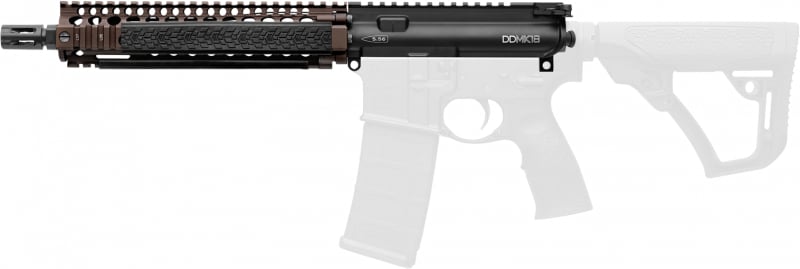
The original is a short-stroke gas piston rifle, which is a genuine mechanical difference rather than a cosmetic one. Piston systems keep more fouling and heat out of the receiver, which matters on a heavily suppressed short barrel.
A direct impingement AR-15 build gets you the same silhouette and the same capability for far less money, with somewhat more cleaning. Our DI vs piston comparison covers the trade honestly.

The light still matters
A white light is not redundant just because you have night vision and a laser. Goggles come off, situations change, and positive identification sometimes requires white light.

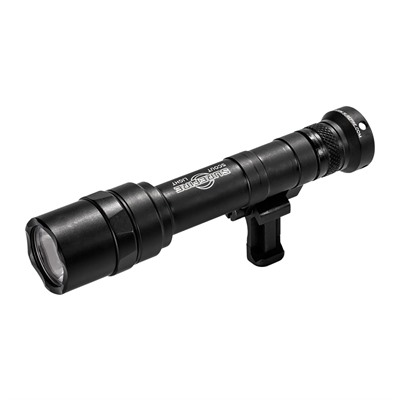
Position it so your support thumb reaches the switch without breaking grip, and mount the laser where it will not be blocked by your hand.
Build it in the right order
Rail space on a short handguard runs out fast, and this build wants a laser, a light, and somewhere to hold on. Decide placement before you buy.
- Mount the optic and confirm your head position.
- Place the laser where it clears your support hand.
- Place the light where your thumb lands naturally.
- Add a hand stop last, in whatever space remains.
Doing it in the other order is how people end up with a light they cannot reach.
Zeroing a laser is its own job
One practical thing nobody mentions until you own a laser: zeroing it is a separate exercise from zeroing your optic, and it needs to be done in the dark.
The laser and the optic are two independent aiming devices on the same rifle. Having them agree at a chosen distance takes a night session, a safe range that permits it, and patience. Most people zero the laser at a shorter distance than their optic, because the laser is for close work.
Budget a whole session for it rather than assuming it will take ten minutes at the end of a range trip.
The honest assessment
This is an expensive build and most of the cost is not the rifle. Night vision, a quality infrared laser and a suppressor together cost multiples of the carbine, and without all three the configuration does not make sense.
If the budget is not there, build a short suppressed carbine in the Mk18 or CQBR pattern first, which is the same silhouette without the night fighting stack, and add to it over time. Our Sicario task force build is that rifle, part by part.
Filed underClone Build/AR-15/5.56 NATO/Lasers/CQB/Suppressed/Build Guide
FAQ
Frequently asked questions
What rifles were used in the Bin Laden raid?
- Short-barrelled, suppressed carbines in the 10 inch class, configured around night vision. Exact unit configurations are not public, and film depictions vary between scenes, so treat any parts list as inspired-by rather than documented.
Why is the laser more important than the optic on a night build?
- Under night vision goggles you cannot comfortably get behind an optic, so aiming moves to an infrared laser mounted on the rail. You point the rifle, see the laser on target through the goggles, and shoot. The optic becomes the daylight backup.
Do I need a night vision compatible optic?
- Yes, if you intend to use it under goggles. NV settings are brightness levels low enough to be usable without blooming into a white smear. Most quality red dots include them and many budget optics do not, so check the specification rather than assuming.
Why suppress a night raid rifle?
- Muzzle flash destroys night vision for you and everyone near you, and an unsuppressed short 5.56 fired indoors at night is debilitating for anyone wearing goggles. A suppressor reduces flash along with blast and noise. Plan for an adjustable gas block.
Do I need a piston gun for this build?
- No. The original is a short-stroke piston rifle, which keeps more fouling and heat out of the receiver on a suppressed short barrel. A direct impingement AR-15 achieves the same silhouette and capability for far less money with somewhat more cleaning.
How much does a night vision build cost?
- Far more than the rifle. Night vision, a quality infrared laser and a suppressor together typically cost several times the carbine, and the configuration does not make sense without all three. Building the Mk18 or CQBR first and adding over time is the sensible path.
Written by
GPP Editorial TeamAR Build Specialists
GunPartPicker guides are powered by data from real builds. What builders actually select tells the story.
Read next
All guides → CLONE BUILD/10.14.26Act of Valor build: the Bandito Platoon SEAL carbine
 CLONE BUILD/09.16.26Sicario Task Force Build: The Parts List
 CLONE BUILD/10.20.26The Terminal List Build: A Working SOF Carbine
 CLONE BUILD/10.14.2613 Hours Build: The Contractor Carbine
 CLONE BUILD/10.15.26Black Hawk Down build: the Ranger and Delta carbines on screen
 CLONE BUILD/09.16.26CQBR Block I Clone Build Guide: Every Part You Need
 CLONE BUILD/09.16.26CQBR Block II Clone Build Guide: The Daniel Defense Upgrade
 CLONE BUILD/10.30.26FBI Regional SWAT clone build: Colt 11.5 and green Mk4 Federal rail
Tools for this guide
- Legal toolGun Travel CheckerCan I bring my gun to another state? Pick where you start, where you are going and what is coming along: carry pistol, AR-15, magazines, suppressor, SBR, brace, forced reset or binary trigger, hollow points. Every state on the route is checked for transporting firearms across state lines: magazine limits, assault weapon bans, NFA rules, carry permit type and trigger bans, with what to do before the state line.
- Compatibility toolHow the Gas System Works (3D)Watch a shot's gas go up an AR-15's gas port, through the gas block and back down the gas tube to the bolt carrier in slow motion 3D. Turn it down with an adjustable gas block, and see where the port sits on pistol, carbine, mid length and rifle gas.
- Legal toolSBR Planner (3D)Set the barrel anywhere from 7.5 to 16 inches, put a stock, a brace or a folder on the back, pin a muzzle device or slide on a can. The ruler under the rifle shows whether you've cleared the 16 inch barrel line and the 26 inch overall line. Pick your state for its SBR, suppressor and assault weapon rules, then price every part and open the build in one click.