Adjustable Gas Block vs Heavier Buffer: Fixing a Suppressed AR-15, in 3D
Can on and brass at 1 o'clock: turn the gas down or add buffer weight? Turn an adjustable gas block's screw in 3D and watch less gas reach the bolt carrier, or step from H to H2 and H3 and watch the same gas push more weight. See where the brass lands, the carrier speed, the gas at your face and when it short strokes.
Quick answer
- A heavier buffer leaves the gas alone and gives it more mass to push, so the carrier runs slower. An adjustable gas block's screw cuts how much gas reaches the carrier.
- In this tool's cycle model a 16" carbine gas rifle with a baffle can and an H buffer throws brass to about 2:30; an H2 buffer or the gas block 1 click in brings it back to 3 to 4 o'clock.
- On an 11.5" with a baffle can no carbine buffer is enough on its own in the model; the gas block 3 clicks in tunes it.
Source: this tool's cycle model (the buffer system tool's), maker guidance on tuning suppressed rifles.
Tune a suppressed AR-15 two ways, in 3D
Pick the barrel and the can, then fix it with buffer weight or the gas block's screw. Watch the carrier cycle in slow motion, cut open, and see where the brass lands and how much gas you eat.
Loading the 3D view
H buffer · gas block open11.5" carbine gas · baffle can · 1000x slower
3.8 oz. Same gas, more mass to push: the carrier runs slower. Comes in steps, and too heavy won't lock back.
The screw narrows the path to the gas tube: less gas reaches the carrier. Retune it for each can and ammo.
The bullet passes the gas port. Gas runs back down the gas tube, through the carrier key into the chamber behind the bolt's gas rings, and drives the carrier rearward while the bolt stays locked.
OvergassedOvergassed. Brass goes forward to 1:00 and the carrier slams the back of the tube. Add a buffer step or turn the gas block in.
Brass lands at
1:00
3 to 4 is tuned
Carrier speed
19.0 ft/s
2.6 J into the tube
Gas at your face
High
mostly from the barrel: a gas block barely helps
Locks back on empty
Yes
3.6" of 3.6" travel
Both ways to tuned
On an 11.5 inch with a baffle can, no carbine buffer is heavy enough on its own; the gas block 3 clicks in tunes it with an H buffer.
A teaching model, not a measurement: the buffer system tool's cycle with a mil-spec carbine spring; the gas block's clicks are illustrative steps, not one maker's. Starting buffer for your barrel
Adjustable gas blocks in stock
Ranked by what builders add most, in stock first. One listing per model.


H2 and H3 buffers in stock
Ranked by what builders add most, in stock first. One listing per model.


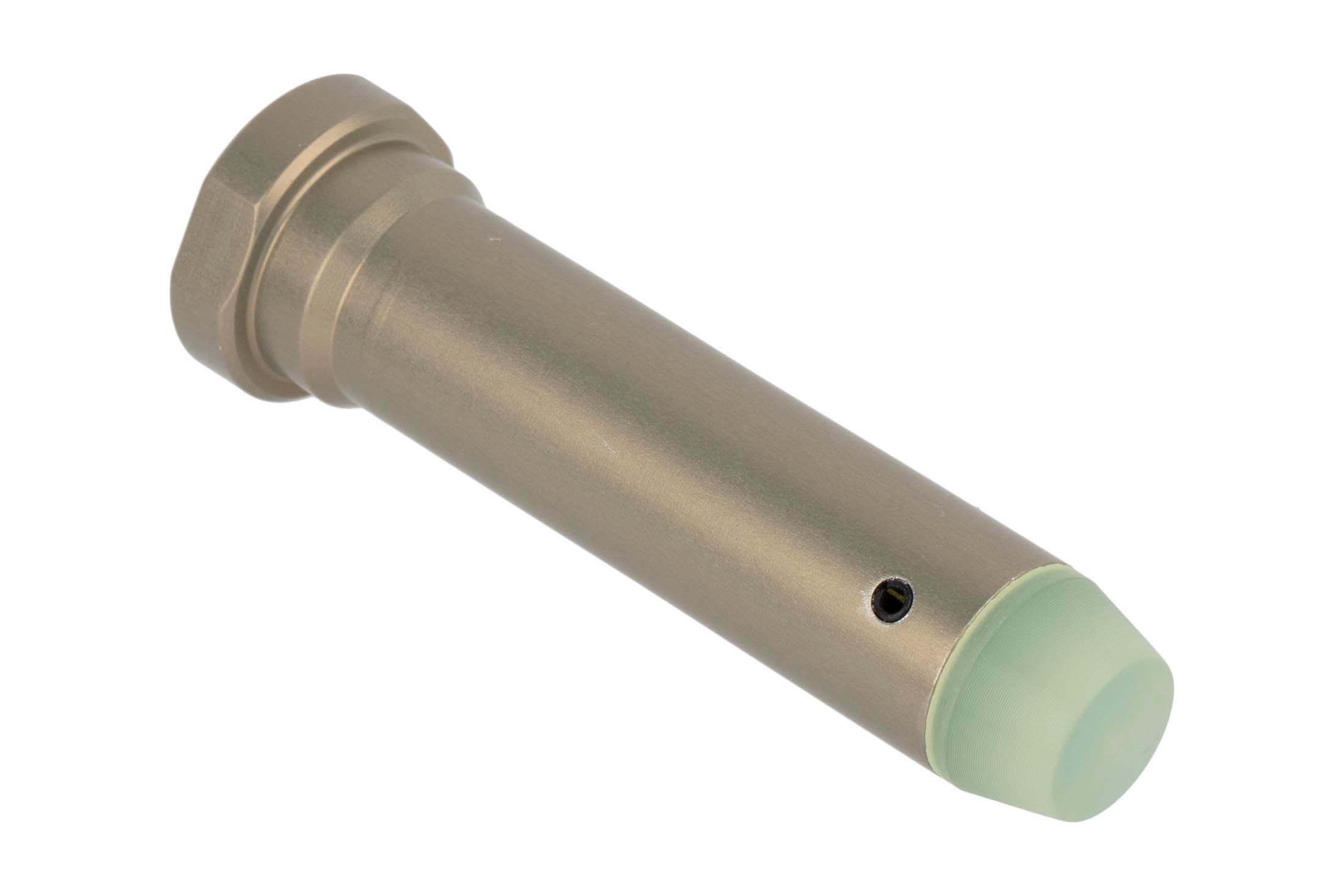

Adjustable gas block vs heavier buffer: what each one does
An adjustable gas block puts a metering screw or a detented valve in the gas path between the barrel's port and the gas tube. Turn it in and less gas reaches the bolt carrier, so it is pushed less hard: same can, brass back at 3 to 4 o'clock, softer recoil, less wear. It can go far past what any buffer absorbs, and some close fully for single shots.
A heavier buffer leaves the gas alone. It adds mass behind the carrier, so the same push moves it slower: the bolt unlocks a touch later, brass lands further back and the carrier hits the back of the tube softer. It comes in fixed steps (H, H2, H3) and never drifts.
Each has its catch. A restrictive screw can carbon up and seize or drift off its setting, and it needs retuning for each can and each ammo. A buffer heavy enough for the can may not lock back on an empty magazine with the can off, with weak ammo or in the cold.
How much buffer or gas block does each barrel need?
This tool's model, carbine gas and a mil-spec carbine spring. Brass is with an H buffer and the gas block open; then the lightest buffer that tunes it, and the fewest clicks that tune it with an H.
| Barrel and muzzle | Brass, H buffer, open | Buffer that tunes it | Gas block with an H |
|---|---|---|---|
| 16" no can | 3:30 | Carbine buffer | Open |
| 16" baffle can | 2:30 | H2 buffer | 1 in |
| 16" flow-through | 3:00 | Carbine buffer | Open |
| 14.5" no can | 3:00 | H buffer | Open |
| 14.5" baffle can | 2:00 | H3 buffer | 2 in |
| 14.5" flow-through | 2:30 | H buffer | Open |
| 11.5" no can | 2:00 | H2 buffer | 1 in |
| 11.5" baffle can | 1:00 | Not enough | 3 in |
| 11.5" flow-through | 2:00 | H3 buffer | 2 in |
| 10.3" no can | 1:30 | H3 buffer | 2 in |
| 10.3" baffle can | 1:00 | Not enough | 4 in |
| 10.3" flow-through | 1:00 | Not enough | 3 in |
Will an adjustable gas block stop gas in my face?
Not on its own. With a baffle can most of the gas at your face comes back down the barrel and out of the chamber when the bolt unlocks; the gas block only cuts what rides the gas tube into the carrier. It helps a little, a buffer helps less, and a flow-through can or a gas busting charging handle helps most. See inside each kind of can.
Which should I use?
Can on full time and only a little overgassed: add buffer weight. It is cheap, takes a minute and never needs retuning.
Can on and off, a short barrel, or too overgassed for an H3: tune the gas. Pick a block with a positive detent you can set by feel, and note the setting for each can and ammo.
Both: many suppressed short barrels run an H2 and a gas block a click or two in, which keeps margin for cheap ammo and cold days. Not sure where you start? The buffer weight calculator gives a first buffer for your barrel, gas system and muzzle.
Frequently Asked Questions
Is an adjustable gas block or a heavier buffer better for a suppressor?
It depends on how much you swap the can. Run the can all the time on a rifle that's only a little overgassed: add buffer weight, it's simple and never drifts. Swap the can on and off, or run a short barrel that's very overgassed: an adjustable gas block, because one buffer can't be right both ways and a gas block can cut more than an H3 can absorb.
Does an adjustable gas block reduce gas in your face?
Some, but it doesn't fix it. A gas block only cuts the gas that runs back down the gas tube to the carrier. With a baffle can most of the gas at your face comes back down the barrel and out of the chamber when the bolt unlocks. A flow-through can and a gas busting charging handle do more for your face.
What buffer should I use with a suppressor?
Usually one step heavier than you run bare: an H2 on a 16 inch carbine gas rifle, an H2 or H3 on a short barrel. Then read the brass: 3 to 4 o'clock is tuned, 1 to 2 is still overgassed, 5 and later is too heavy.
Can a buffer be too heavy?
Yes. Too much mass and the carrier doesn't travel far enough to pick up the next round or catch the bolt stop: weak ejection, no lock back on an empty magazine, and it gets worse with weak ammo or in the cold. If the rifle stops locking back, go a step lighter.
What are the downsides of an adjustable gas block?
Two. A tightly restricted screw can carbon up and seize, or drift off its setting, so pick a block with a positive detent. And you have to retune it for each can and each kind of ammo; a setting that runs suppressed with hot ammo may not cycle bare or with cheap ammo in the cold.
What does closed mean on an adjustable gas block?
No gas reaches the carrier, so the rifle won't cycle: you work the charging handle for each shot. Some shooters use it for the quietest possible subsonic shots. Turn it back open before you expect it to run as a semi auto.
Cite this tool: GunPartPicker, “Adjustable Gas Block vs Heavier Buffer: Fixing a Suppressed AR-15, in 3D”, https://gunpartpicker.net/tools/adjustable-gas-block-vs-heavy-buffer. The cycle is a teaching model; gas block clicks are illustrative steps, not one maker's. Free to cite with attribution.
Read next
All guides →

More Gun Tools
- TuningBuffer System (3D)Watch an AR-15 cycle in slow motion, cut open: gas drives the bolt carrier back, the bolt unlocks and throws the brass, the buffer and spring soak it up and send it home. Swap carbine, H, H2 and H3 buffers, add gas or a suppressor, and see the carrier speed, where the brass lands and when it short strokes.
- TuningBuffer Weight CalculatorEnter your gas system, barrel length, buffer tube and ammo, add a suppressor or a fast trigger, and get the buffer weight to start with plus the buffers in stock that match.
- TuningSuppressor Types (3D)How does a suppressor work inside? Cut a can in half in 3D and fire one shot through a cone baffle stack, a one piece monocore and a flow-through can. Watch the gas swirl, zigzag or run straight out the front, see how much comes back at your face, and where the brass lands on a 16 inch carbine or an 11.5 inch SBR.
- CompatibilityHow the Gas System Works (3D)Watch a shot's gas go up an AR-15's gas port, through the gas block and back down the gas tube to the bolt carrier in slow motion 3D. Turn it down with an adjustable gas block, and see where the port sits on pistol, carbine, mid length and rifle gas.
- LegalGun Travel CheckerCan I bring my gun to another state? Pick where you start, where you are going and what is coming along: carry pistol, AR-15, magazines, suppressor, SBR, brace, forced reset or binary trigger, hollow points. Every state on the route is checked for transporting firearms across state lines: magazine limits, assault weapon bans, NFA rules, carry permit type and trigger bans, with what to do before the state line.
- PlanningAR Build Cost CalculatorHow much does it cost to build an AR-15? Pick caliber, barrel length, stock or brace and optic, then drag both edges of the price band from the cheap end to the top end. Every slot fills with the part builders add most that is in stock, priced live. The headline total is the core rifle, optics and extras are priced separately, and beside them sits what builders really pay per slot, measured from real part picks. Roll a random build, or open yours in the builder in one click. Computed from over 1 million AR parts selected on GunPartPicker since 2020.
- CompatibilityMuzzle Thread CheckerPick your barrel's caliber and platform, get the standard thread pitch, and see every muzzle device and suppressor in the catalog that actually threads on, with live prices.
- CompatibilitySuppressor Mounts (3D)Put a can on its mount in 3D. Compare SilencerCo ASR, Dead Air KeyMo, SureFire Fast-Attach, HUXWRX QD, Plan B, HUB 1.375x24 and direct thread: what goes on the barrel, what is on the can, how it locks and which cans fit which mounts. Cut it open to see the taper and the baffles, then shop the mounts and cans in stock.
- CompatibilityDI vs Piston (3D)Watch a direct impingement AR-15 and a gas piston HK416 fire in slow motion x-ray 3D. Follow the gas from the port back into the carrier, or into a piston that kicks an op rod, see which bolt runs hot, and compare weight, cleaning, suppressed use, carrier tilt and cost.
- CompatibilityUpper vs Lower Receiver (3D)Take a real AR-15 apart in 3D and see how the upper and lower receiver go together. Push the takedown pin, hinge the upper open on the pivot pin, pull the bolt carrier group and lift the upper off, with every part colored by the half it belongs to.
- CompatibilityHow Muzzle Devices Work (3D)Watch one shot leave an AR-15 muzzle in slow motion 3D through a bare barrel, a flash hider, a compensator, a muzzle brake and a linear comp. See where each sends the gas, and what that does to flash, recoil, muzzle rise and the blast beside you.
- CompatibilityHow a BCG Works (3D)Watch an AR-15 bolt carrier group unlock, extract and lock again in slow motion 3D, then take it apart part by part. See the cam pin turn the bolt out of the barrel extension, and what each part does.
- CompatibilityBuffer Tube and Stock (3D)See an AR-15 buffer tube, end plate, castle nut and stock go on in 3D, walk the stock through its six positions, and put a mil spec and a commercial tube side by side to see why a stock only fits one of them.
- CompatibilityHow a Charging Handle Works (3D)Watch an AR-15 charging handle unlatch and pull the bolt carrier back by its gas key in 3D, then watch the rifle fire while the handle stays put. Compare a standard latch with an ambidextrous one.
- CompatibilityFree Float vs Drop In Handguard (3D)Watch an AR-15 free float handguard go on its barrel nut in 3D, lean on a free float and a drop in handguard to see which one moves the barrel, and lock an M-LOK rail section in. Plus M-LOK vs KeyMod and what length fits your barrel.
- CompatibilityHow Triggers Work (3D)Watch a standard trigger, a forced reset trigger and a binary trigger run inside an x-ray AR-15 in slow motion 3D. See the hammer, the disconnector, the FRT's locking bar and the bolt carrier at every step, and what each one needs and where it is legal.
- CompatibilityFRT and Binary Trigger PickerChoose your platform and see every forced reset trigger, binary trigger and Super Safety the catalog carries for it, what the host needs to run one, and where each is in stock.
- CompatibilityGlock Red Dot Fit CheckerPick how your Glock slide is cut and see which red dots mount directly, which need a plate, and the plates and optics in stock right now.
- CompatibilityGlock Size ComparisonPick any two Glocks and see them to scale as real photos sized to Glock's published dimensions, side by side, from behind and as an X-ray, with the difference in length, height, width and weight in one line and the pistols in stock for each.
- CompatibilityP385 Size ComparisonSee the SIG P385 CARRY, COMP and FULL to scale against the P365-XMACRO, the P320 and the Glock 19, 17, 45 and 43X, as real photos sized to the published length and height, with every dimension and where to order one.
- Paint plannerGun Paint PlannerRattle can guns online before you spray. Paint, stencil and camo a real photo of about 1,800 guns: AR-15s, AR-10s, AR-9s, AKs, every Glock, pistols, shotguns and bolt action rifles, the way the rattlecanned guns on r/rattlecannedguns are done, with Krylon, Rust-Oleum, Aluma-Hyde, DuraCoat and Cerakote colors, then get the cans to buy in spray order.
- TuningTwist Rate CalculatorPick a bullet and a twist rate, get the Miller stability factor, then see barrels with that twist and ammo loaded with that bullet, with today's price per round.
- TuningOptic Zero (3D)See where a 25, 36, 50, 100 or 200 yard zero hits on a 3D range, with your ammo, barrel length and optic height. Compare two zeros side by side, look through your red dot, EOTech or LPVO at each distance, then tap where your group hit and get the exact clicks up, down, left and right for your optic.
- LegalBarrel and Overall Length CheckerEnter barrel length, muzzle device and how the back end is configured, and see whether the build is a rifle, a short barreled rifle, a pistol or an AOW under federal law, with the barrels in stock at that length.
- LegalSBR Planner (3D)Set the barrel anywhere from 7.5 to 16 inches, put a stock, a brace or a folder on the back, pin a muzzle device or slide on a can. The ruler under the rifle shows whether you've cleared the 16 inch barrel line and the 26 inch overall line. Pick your state for its SBR, suppressor and assault weapon rules, then price every part and open the build in one click.
- PlanningNight VisionLook around a real 360 degree scene through Gen 1, Gen 2+, Gen 3 green and white phosphor tubes, digital night vision and thermal. Turn the moon down from full to overcast, switch on an IR light, compare two devices side by side. Or walk a 3D farm at night and spot the people, hogs and deer hiding in it. Then see the PVS-14, PVS-31, GPNVG-18 and the thermal scopes people buy, with prices.
- Planning300 BLK vs 5.56 Race (3D)Race a 9 inch .300 Blackout against a 10.3 inch 5.56, or up to four rifles of your own, down a 3D range. Every rifle fires at once in slow motion, and you get each one's time, speed, energy and drop at 100 to 500 yards.
- CompatibilityCo-Witness Checker (3D)Put a micro red dot, a full size dot or an EOTech on an AR-15 at 1.41, 1.535, 1.57, 1.93 or 2.26 inches and see where your iron sights land in the window, in 3D: absolute, lower 1/3, or under the window.
- PlanningAmmo Cutaway (3D)Cut M193, M855 green tip, M855A1, 77 gr OTM and .300 BLK supersonic and subsonic in half and compare them side by side in 3D: what each bullet is made of, its speed from short barrels, steel targets, and today's price per round. Then watch a .300 BLK round go into a 5.56 chamber.
- TuningWill It Eat Cheap Ammo? (3D)Pick your ammo and your AR-15: barrel and gas length, gas block, buffer, chamber, extractor and how clean it is. See if it will cycle and extract cheap steel case or bulk .223, which part is the weak link on a real 3D rifle, and try each fix to watch the answer change.
- PlanningAstigmatism Optic Test (3D)See a red dot, a circle dot, an EOTech, a prism and an LPVO through eyes with astigmatism, on a 3D AR-15. Pick how strong it is, the light, which way your dot smears and the brightness, and every optic is ranked for those eyes.
- PlanningOptics Without Power (3D)Cut the power to a red dot, an EOTech, a prism, an LPVO or an ACOG on a 3D AR-15 and see what's left in the window, by day and at night, with or without backup iron sights. For a dead battery, a cold morning or an EMP.
- TuningMechanical Offset (3D)See how far under the dot an AR-15 hits at 3 to 25 yards, in 3D: pick your optic height, zero and caliber, and the view through the optic shows the hole under the dot on a 3x5 card, with the hold for every distance.
- TuningEjection Pattern (3D)Tap where your brass lands and a real 3D AR-15 throws it there and tells you if it's overgassed, tuned or short on gas. Or set up your rifle (barrel and gas length, buffer, spring, gas block, suppressor, ammo) and watch where the brass goes, then try each fix and see it move.
- CompatibilityCaliber Conversion (3D)Convert a 5.56 AR-15 to .300 Blackout, 6.5 Grendel, 6mm ARC, .224 Valkyrie, 7.62x39, .350 Legend, .450 Bushmaster, 9mm or .22 LR and see on a real 3D rifle which parts you swap: the barrel, the bolt, the magazines, the buffer, and what stays the same.
- Compatibility5.56 vs .223 Chamber (3D)See a .223 Remington, a 5.56 NATO and a .223 Wylde chamber cut in half in 3D, with a round seated in each. Pick your chamber and your ammo to see where the bullet meets the rifling, why 5.56 in a .223 chamber is unsafe, and why Wylde takes both.
- CompatibilityChrome vs Nitride vs Stainless (3D)See a chrome lined, a nitrided and a stainless 5.56 barrel cut in half at the throat in 3D, then wear them from new to shot out. Compare what each finish is, how long it lasts, how it shoots, and which to buy for your rifle.
- TuningClear AR-15 Jams (3D)See seven AR-15 jams inside a see through receiver in 3D, from a click with no bang to a stovepipe, a double feed, a stuck case and a bolt override, and step through clearing each one. Learn when tap, rack works and when it doesn't.
- TuningTwist Rate and Keyholing (3D)What does 1:7 twist mean, and why does it matter? Fire a bullet down a rifled barrel in 3D and watch it spin, fly and hit the paper. Pick 55, 62 or 77 grain, a 1:7, 1:8, 1:9 or 1:12 barrel, the distance and the air temperature, and see a stable round hole, a wobbling bullet or a keyhole.
- AmmoBallistic Gel (3D)Fire M193, M855, 77 gr OTM, .300 Blackout 110 gr TAC-TX or 220 gr subsonic into a block of ballistic gel in 3D, from a 10.3 to 20 inch barrel at 10 to 300 yards. Watch the bullet yaw, break up or open in slow motion, see the stretch cavity and the wound it leaves, how deep it goes against the FBI's 12 to 18 inches, and how far out your barrel keeps 5.56 fast enough to fragment.